The Short Answer
AI visibility in Baltimore is how often, and how accurately, AI answer tools such as Google AI Overviews, ChatGPT, Gemini, Perplexity and Claude find, understand and name a Baltimore business when someone asks a local question. It's sometimes called GEO (generative engine optimization) or AEO (answer engine optimization). It builds on ordinary SEO, and nobody can guarantee a placement.
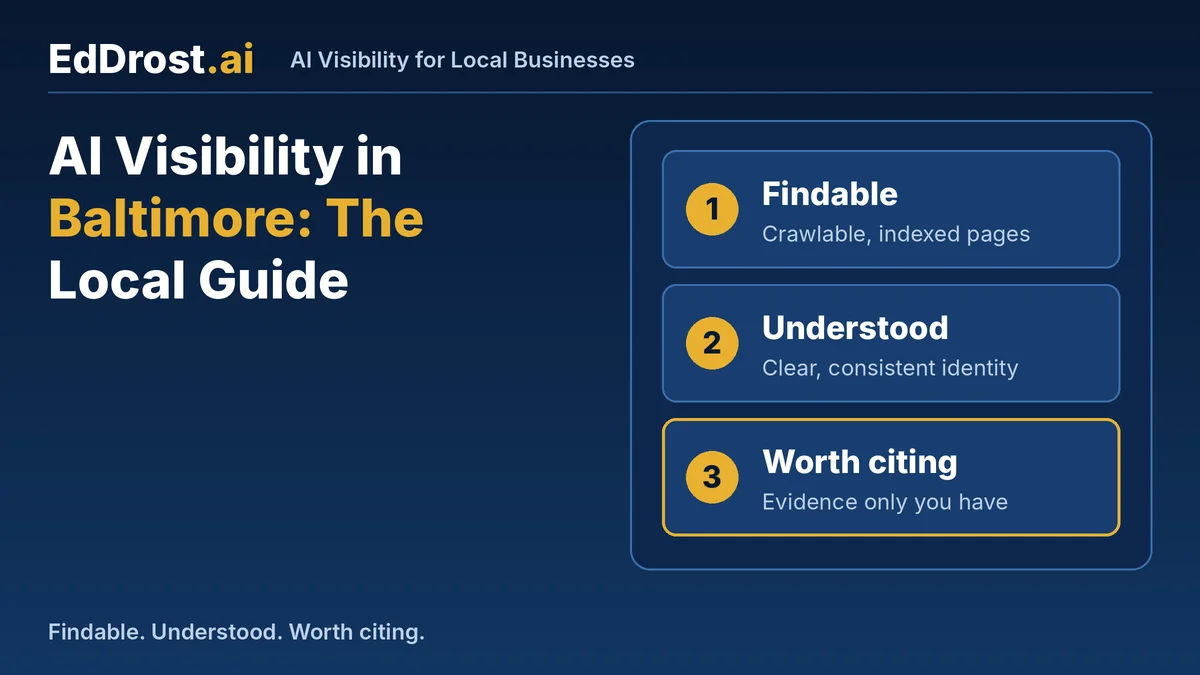
For a Baltimore business there are three jobs: be findable (the machines can reach your pages), be understood (your name, services, credentials and area are clear and consistent), and be worth citing (you publish something specific that a national site can't). This guide covers what that means locally, what your options are, what to ask before you hire anyone, and what you can do yourself this month.
A note up front: I do this work, so I have an interest. I'll tell you where I'm describing someone else's service from their own website, and where I'm speaking from my own experience.
What AI visibility means for a Baltimore business
People are asking full questions now. "Who can appraise an inherited rowhouse in Baltimore County?" "Which Hampden contractor knows old plaster and lath?" "Is a pre-listing appraisal worth it in Towson?" AI tools answer by pulling from several sources and writing one response. Google describes its AI features as giving a comprehensive answer with links to supporting websites.
Two things are different from the old ten-links world:
- The answer may be the whole visit. Pew Research Center tracked the browsing of 900 U.S. adults in March 2025. When a Google results page had an AI summary, people clicked a traditional result link on about 8% of visits, compared with about 15% when there was no summary, and they were more likely to end their browsing session entirely (26% of pages with an AI summary versus 16% without). Pew's own wording: users very rarely clicked the sources cited inside the summaries. That was a 2025 study of U.S. adults in general, not Baltimore, so treat it as direction, not a local forecast.
- Being named matters even without a click. If the assistant says "Ed Drost, a Maryland certified residential appraiser" before the customer ever opens a link, the name did its work. That's also why you need your facts to be right everywhere they might be pulled from.
Baltimore adds its own wrinkles. We have a city and a county that share a name and are separate places. People search by neighborhood (Fells Point, Hampden, Canton, Federal Hill, Towson) and by what they call a thing (a rowhouse is a rowhouse here). A national agency's template page for "Baltimore" often can't tell a customer anything specific. A local professional can.
Mentions, citations and customers are three different results
A tool can name your business, cite your website as a source, or neither, and a customer can contact you through any route. Don't let anyone fold those into one number. I explain the difference, with real research on how often brands get mentioned without a link, in a separate article this weekend. For now, remember that when you test your own business, record mentions and citations separately.
What actually gets a page into Google's AI answer
Here's what Google itself says, because it's the least hyped source. A page has to be indexed and eligible to appear in Search with a snippet to be shown as a supporting link, and Google lists the basics in its AI features documentation: allow crawling in robots.txt and through any CDN or host, make content easy to find through internal links, give users a great page experience, keep important content in text form, support it with good images and video where it fits, and make sure structured data matches the visible text. Search Engine Journal's reading of that documentation is that Google's systems choose the links automatically and there is nothing special for site owners to do beyond Google's regular guidance.
That has two consequences. First, anyone who sells a secret AI Overview trick is selling something Google says doesn't exist. Second, the real work is the unglamorous kind: be reachable, be clear, be accurate, and say something nobody else says.
Your options in Baltimore
Here's how I'd sort them. These aren't ranked, and I haven't used the services named. What I say about them comes from their own websites on November 21, 2026. Prices and offers change, so check before you rely on any of it.
| Option | What it is | Best for | Watch for |
|---|---|---|---|
| Do it yourself | Fix your site, profile and content using free tools and the checklist below. | Owners with time who like to learn. | It takes steady effort, and the first month of testing is where most people stop. |
| Tracking software | A tool that asks AI platforms questions about your business and reports what comes back. Example: Rankall.io says it scans 11 AI platforms to show whether they recommend you or your competitors, suggests fixes and rescans. Its site lists a free scan and paid plans from $15 a month (personal brands) and $39 a month (local businesses). Its examples are from other cities, and I didn't find Baltimore benchmarks on its page. | Measuring a baseline and watching change. | A tool shows you the score. It doesn't write the content or fix the site. |
| Platform guides and benchmark pages | Vendors publish city pages. Presenc AI's Baltimore page, last updated April 23, 2026 by its own account, discusses Baltimore sectors including healthcare, cybersecurity, defense, biotech and education and suggests the kinds of questions those businesses need to show up for. | Idea-gathering and competitor awareness. | These are marketing pages. Read the method before trusting a number. |
| Agencies | Teams that do the content, technical and measurement work. Several have Baltimore pages, such as Thrive Agency, WebFX and Ignite Visibility. | Larger budgets and multi-location businesses. | Ask whether the work is specific to you or a template with "Baltimore" inserted. |
| A local specialist | One experienced person who builds your authority content and site. That's what I do. I'm a Maryland certified residential appraiser with 37 years in the Baltimore market, and I built EdDrost.AI around the 24-Signal Authority Method. | Experienced professionals and small firms that want their own expertise made visible. | One person has limits on volume and hours. Ask what's included and what isn't. |
One more source worth knowing: cityBiz ran a piece this fall arguing that buyers have quietly moved part of their research to AI answer engines and that the tools businesses use to track visibility weren't built to look there. I couldn't load the full article, so I'm only citing that one point. It matches what I see: most owners have a Search Console login and no idea what ChatGPT says about them.
Seven questions to ask any Baltimore AI visibility provider
- "Can you guarantee I'll be cited?" The honest answer is no. Google says it picks the links automatically, and ChatGPT and the others decide for themselves. A guarantee is a reason to keep shopping.
- "What's my baseline?" Before any work, you should get a written record of what AI tools say about your business for ten to twenty real customer questions: who was mentioned, who was cited, what was wrong.
- "What will you actually change on my site?" Look for specifics: pages, answers, markup, listings. "Optimization" isn't a deliverable.
- "Whose expertise ends up on my pages?" If the content doesn't come from you or your people, it can't carry original evidence. Generic copy is what AI tools already have plenty of.
- "How do you handle accuracy?" A wrong address, license or service in an AI answer is a real problem. A good provider checks it and fixes the source.
- "How will we know it's working?" The right answers include qualified inquiries and booked work, not only impressions or mentions. I wrote a measurement guide if you want the routine.
- "What does it cost all in, and how do I leave?" Get setup fees, monthly fees, your own time, and the exit terms in writing.
What you can do yourself this month
This is the short version of my 20-step checklist. Even if you hire help later, these are the things that have to be true.
- Make sure Google can reach and index your key pages. Verify your site in Google Search Console, read your robots.txt, and inspect your homepage and three most important service pages.
- Answer your top ten customer questions on your own site. Put the answer first and the nuance after it. Cost, timing, what's included, what happens next.
- Add the questions customers don't know to ask. That's where experience shows. An appraiser knows to ask what effective date the valuation needs. A roofer knows to ask what's under the shingles. See my piece on Should-Ask questions.
- Say who you are, the same way everywhere. Business name, brand name, the person, license number, phone, service area. If the name on Google, your site and your directory listings differ, fix it. I cover that in Entity Clarity.
- Complete your Google Business Profile. Category, services, hours, service area, website, and real photos.
- Write for the places you actually serve. A page on Towson, Parkville or Fells Point should say something true about that place, not swap the neighborhood name in a template. Read why city-swap pages fail and the neighborhood approach.
- Publish proof only you have. Anonymized case examples, local observations, your own photographs and methods. Google's guidance leans on original, useful content, and original is the one thing a national site can't copy from you. See information gain.
- Earn real mentions elsewhere. Your licensing board or association directory, a local publication, a chamber or community organization, a legitimate interview. Not purchased links, not invented reviews.
- Test and write it down. Pick ten questions a Baltimore customer might ask, run them in Google, ChatGPT and at least one other tool, and record the date, the exact wording, who's mentioned, who's cited and whether it's right. Do it again next month.
How it plays out for different Baltimore businesses
- Appraisers, real estate and estate professionals: estate, probate, divorce and tax appeal questions are specific and high-stakes. The strongest pages explain the process, the effective date and the Maryland-specific rules, and say clearly who wrote them and why they're qualified.
- Contractors and home services: older Baltimore housing stock is the advantage. Explain what actually goes wrong in a 1920s rowhouse and what it costs to fix right. That's the page a chain can't write.
- Law, health and other regulated professions: accuracy and compliance come first. Make statements you can support, cite primary sources, and don't promise outcomes.
- Restaurants, venues and consumer brands: hours, menus, events and location details have to be current everywhere, since those are the facts assistants repeat.
I built a live-music directory for Ocean City the same way I built my appraisal authority site: a specific audience, specific answers, consistent identity and structured data. If you want the single-business version, read how Baltimore small businesses approach Google AI Overviews.
What I'd avoid
- Paying for "AI citations." No one can sell a placement that Google and OpenAI decide.
- Fifty near-identical Baltimore pages. Volume without something to say isn't authority.
- Chasing a visibility score with no method behind it. A number from a tool is a starting point. Ask what was tested.
- Letting facts drift. Old hours, old prices, old service areas. AI answers repeat what they find.
- Measuring mentions instead of customers. The goal is a phone call from the right person.
Where I'd start
If you do only one thing this week, run the ten-question test in step nine and see what AI tools currently say about your business. Most owners are surprised, in one direction or the other. Once you have that baseline, the rest of the list becomes a plan instead of a worry.
I've spent 37 years appraising property around Baltimore, and I've learned that the answer is only as good as the evidence behind it. That holds for a valuation and it holds for AI search. Experience builds value. AI builds leverage.
If you'd like help seeing where you stand, start with the Invisible Expert Scorecard, or read how I work on the AI visibility specialist page.
Sources and further reading
- Google Search Central: AI features and your website
- Pew Research Center: Google users are less likely to click on links when an AI summary appears (July 22, 2025)
- Search Engine Journal: AI Overviews and SEO
- Rankall.io and Presenc AI: Baltimore (vendor pages, read November 21, 2026)
- cityBiz: Baltimore businesses and AI search visibility measurement
Reviewed November 21, 2026. Vendor descriptions come from each company's own site and may have changed. Nothing here is a guarantee of any ranking, citation or result.
Frequently Asked Questions
What is AI visibility in Baltimore?
How do I get my Baltimore business into Google's AI Overview?
How much does AI visibility cost in Baltimore?
How long does it take?
Can I do AI visibility myself?
Do I need special schema or an llms.txt file?
How do I check whether AI tools mention my business?
Do AI answers reduce clicks to websites?
Experience builds value. AI builds leverage.