The Short Answer
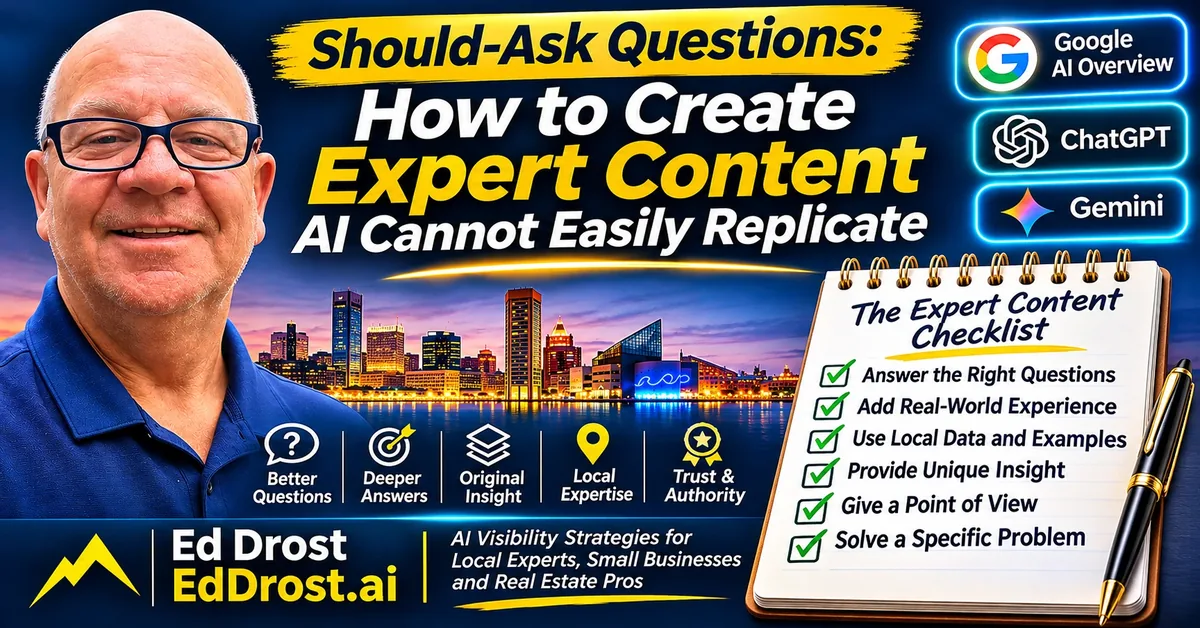
A Should-Ask Question (SAQ) is a question your customer needs answered but does not yet know to ask. Answering it takes real experience, which is why it is hard for a generic page or a generic AI tool to copy well. SAQs are a content method from my own 24-Signal framework. They are not an official ranking factor, and I do not have proof that they earn any particular share of citations.
FAQs Answer What People Ask. SAQs Answer What They Should.
An FAQ is a question people already type into Google or an AI tool. "How much does a home appraisal cost?" is a good FAQ. You should answer it clearly and early.
But the customer who asks about cost does not know to ask a better question: "What can make two homes on the same block appraise differently?" They do not know that question exists. An experienced appraiser does, because it comes up on real assignments constantly.
That second question is a Should-Ask Question. It does three things:
- It protects the customer from a costly mistake.
- It shows, in a way no slogan can, that you have done this work.
- It gives readers, and the tools that summarize for them, something specific they will not find repeated on a thousand other sites.
Why Experience Is the Raw Material
Generic content is easy to produce. Anyone can summarize what already exists. What is hard to produce is the exception, the pitfall, the "it depends, and here is on what." That comes from doing the work for years.
This is why I think experienced professionals have an edge here. Google's own guidance asks for helpful, reliable, people-first content, and it values first-hand experience and original information. SAQs are simply a disciplined way of putting what you know on the page. I am not claiming a mechanism beyond that.
Examples From My Field
Here are a few questions I would want a Baltimore homeowner to ask. Notice that each one points to a decision, not just a definition.
- "Does my property have a historic tax credit, and has anyone accounted for it?" A CHAP credit is specific to the property and can change the numbers. Standard data feeds may not show it.
- "What date does my appraisal need to reflect?" An estate or legal matter may need a value as of a past date, not today. Ordering the wrong kind of report wastes time and money.
- "Is the assessment on my tax bill a fair picture of my home's market value?" If not, there may be an appeal process worth understanding. I would point the reader to the official state source for current rules and deadlines.
- "Why do two similar homes nearby have such different prices?" Condition, renovation quality, parking, and location details often explain it.
Every field has its own list. An accountant has questions about business transitions. A contractor has questions about permits and sequencing. A financial planner has questions about timing. You already know them. You have answered them for clients a hundred times.
How to Find Your Should-Ask Questions
- Mine your "I wish they had asked" moments. Think of every time a client said, "I had no idea that mattered."
- List the corrections you give. What do clients believe that is wrong, incomplete, or outdated?
- Remember the expensive mistakes. What did a client skip that later cost them?
- Collect the exceptions. Where does the usual rule not apply?
- Test the AI tools. Ask them your field's common questions and see where the answers are vague, outdated, or wrong. Those gaps are your opportunities.
How to Structure an SAQ Page
- Use the question as the headline, in plain customer language.
- Give a short, direct answer in the first two or three sentences.
- Explain why it matters, with consequences in plain terms.
- Show a real example, anonymized and permitted.
- State when the answer changes. Exceptions build trust.
- Point to the official source for rules and deadlines.
- Add a clear next step and your credentials.
What I Will Not Claim
I will not tell you that SAQs win a certain percentage of citations or that they are a proven ranking factor. I have not measured that, and nobody outside the AI platforms can. I use SAQs because they make my content more useful and more clearly mine. That is reason enough. If they also help with visibility, I treat it as a bonus I can only observe, not promise.
Mistakes to Avoid
- Writing a generic question and giving a generic answer.
- Letting AI draft it without your experience. AI can help organize and edit. The insight has to come from you.
- Burying the answer. Lead with it.
- Skipping the exception. The exception is often the most valuable sentence on the page.
Frequently Asked Questions
What is a Should-Ask Question?
How is an SAQ different from an FAQ?
Do SAQs guarantee AI citations?
Can I use AI to write my Should-Ask Questions?
The Bottom Line
Anyone can answer the question people already ask. It takes experience to answer the question they should have asked. Start with three: the ones you are tired of explaining after it is too late.
Experience builds value. AI builds leverage.