The Short Answer
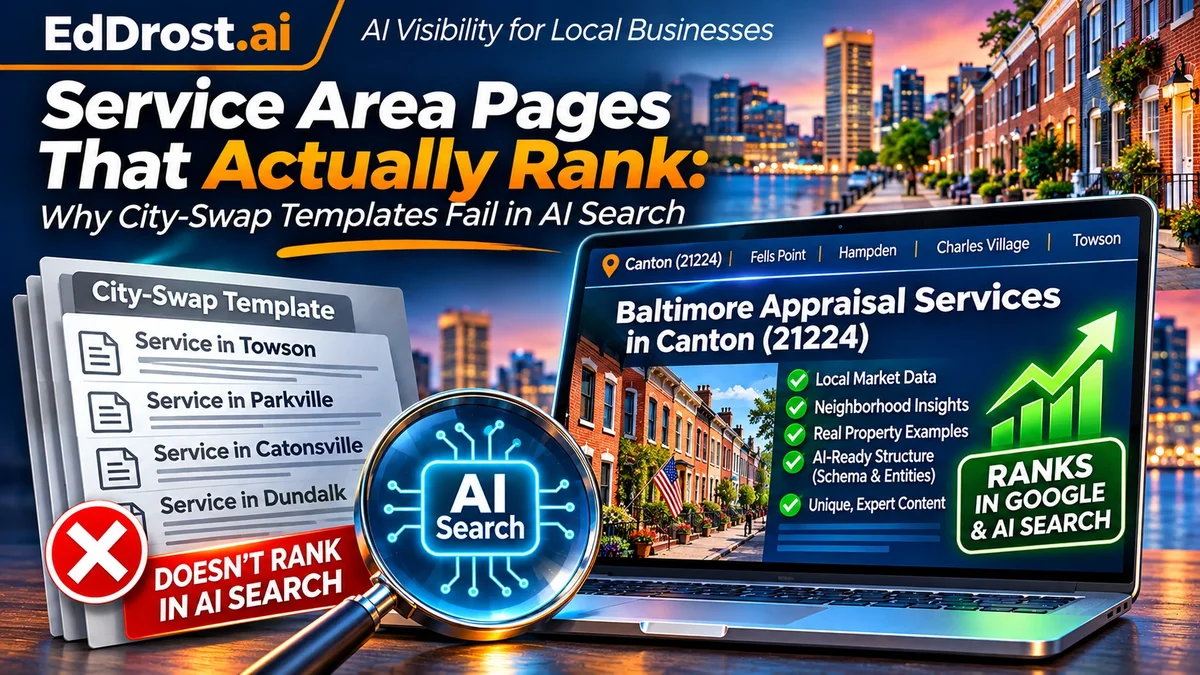
City-swap service area pages, where a business duplicates the same template and swaps out town names like Towson, Columbia, and Annapolis, fail in both Google Search and AI Overviews. Search engines filter near-duplicate pages as low-value doorway content, while AI models skip pages lacking verifiable local evidence. Effective location pages require block-level local details, municipal rules, and completed project proof.
For more than a decade, the standard local SEO agency playbook relied on brute-force volume. If you owned a roofing company, law practice, or home service business in central Maryland, an agency would sell you a package of 40 or 50 "city pages": one for Towson, one for Catonsville, one for Bel Air, one for Ellicott City, and so on down the map.
Every page used the exact same 600-word master draft. The only changes were the town name inside the H1 headline, a swapped meta title, and a generic paragraph scraped from Wikipedia about local parks or population size.
In 2026, that playbook is not just ineffective. It actively holds your domain back. Google's spam and helpful-content systems treat templated city-swap pages as scaled doorway content, which can mean withheld indexation or pages buried deep in results. Meanwhile, generative engines like Google AI Overviews, ChatGPT, and Perplexity have little reason to cite them, because they contain no verifiable proof that you have ever worked in that community.
Understanding what AI visibility requires for local specialists means replacing cookie-cutter town templates with pages built on real, block-level field experience.
Why AI engines reject city-swap location pages
When a homeowner in Lutherville-Timonium or Canton asks an AI assistant for a local contractor, appraiser, or specialist, the model does not look for the webpage that repeats the town name the most times. It evaluates entity corroboration and situational expertise. Templated location pages fail across three retrieval checks:
- Zero information gain. If 85% of the text on /hvac-repair-owings-mills is identical to /hvac-repair-pikesville, retrieval systems recognize immediately that neither page offers unique value. (More on this in Information Gain.)
- Absence of local constraints. Real local work is shaped by local conditions: zoning rules, housing stock age, soil drainage, utility hookups, or historic district boards. A generic template that reads "We offer fast, affordable service in [City]!" proves the author knows nothing about working there.
- No off-page corroboration. When a website claims to serve 45 Maryland municipalities, yet every single Google review and project photo comes from one ZIP code, AI models discount the unverified location claims.
As we saw in our 72-hour Baltimore case study, hyperlocal pages earn rapid visibility and AI Overview citations when each page carries genuine neighborhood-level substance that national aggregators cannot replicate.
What makes a service area page verifiable to AI
To convince both Google's ranking systems and generative answer engines that your business is an active, authoritative provider in a specific town or ZIP code, every location page needs four concrete layers of proof.
1. Local housing, infrastructure, or regulatory specifics
Anchor your explanation in the real physical or legal conditions of that community. A buyer reading your page, and an AI parsing it, should immediately recognize that you work in the field there:
- Baltimore City neighborhoods (e.g., Federal Hill, Bolton Hill, Mount Vernon): address Commission for Historical and Architectural Preservation (CHAP) exterior guidelines, 19th-century brick rowhome party walls, alley access limitations for dumpsters or equipment, or ground-rent nuances.
- Northern Baltimore County (e.g., Parkton, Monkton, Sparks): discuss multi-acre rural zoning, private well-and-septic inspection timelines, steep-grade driveway access, and agricultural preservation easements.
- Harford County (e.g., Bel Air, Forest Hill, Abingdon): reference county landfill and transfer station disposal rules, HOA architectural review boards in newer subdivisions, and Route 24 / I-95 dispatch corridors.
2. Real completed work from that area
Nothing proves local presence faster than documenting actual projects completed in that municipality. Include a brief "Recent Work in [Town/Neighborhood]" section summarizing two or three real jobs (protecting client confidentiality):
- The property & problem: "1928 detached colonial near Lake Roland in 21210 needing a retrospective date-of-death valuation for estate settlement."
- The local constraint: "Limited comparable sales within half a mile due to custom lot sizes and ravine topography."
- The outcome: "Delivered a fully documented, IRS-compliant appraisal report within four business days."
3. Honest dispatch, travel, and scheduling logistics
Instead of pretending you have a brick-and-mortar storefront in every town, state clearly how you serve the area from your home base. Mention drive-time windows, regular service days for that county, and whether emergency or weekend appointments apply. Transparency builds trust with both human readers and AI verification models.
4. Neighborhood-specific FAQs and Should-Ask questions
Never paste the exact same five company FAQs at the bottom of every location page. Write three to five questions unique to property owners in that specific town, combining standard buyer questions with the insider Should-Ask Questions covered in the 24-Signal Authority Method.
Side by side: city-swap template vs. authority location page
| Page component | Legacy city-swap template | AI-ready authority location page |
|---|---|---|
| Opening 50 words | "Looking for the best [Service] in [City], MD? Our team provides reliable, affordable solutions..." | Direct, answer-first summary defining what you do in [City], typical turnaround, and the exact local property types you serve |
| Local context | Copy-pasted trivia about town history, population, or local parks | Local codes, property styles, soil/weather factors, or permitting timelines that directly affect the job |
| Evidence of work | Stock photos and generic sitewide testimonials | Anonymized local case notes, real field photos, and customer reviews naming that town or ZIP code |
| FAQs | Identical 5 questions repeated across 30 URLs | Custom local questions reflecting municipal rules, pricing variables, and common homeowner mistakes in that area |
| Structured data | Basic sitewide Organization tag | LocalBusiness or Service JSON-LD with explicit areaServed entities mapped to verified cities and ZIP codes |
Build five deep pages before fifty shallow ones
If your business serves multiple counties across central Maryland, resist the temptation to launch dozens of thin town pages at once. Publishing 40 hollow URLs dilutes your crawl budget and signals low quality across your entire domain. Follow a disciplined three-step rollout instead:
- Select your top five revenue hubs. Pick the five municipalities, counties, or Baltimore ZIP codes where you already have completed jobs, local photos, and customer reviews.
- Build one 800-to-1,200-word authority page per hub. Include local regulatory or property context, two real project summaries, clear pricing or turnaround ranges, and location-specific FAQs.
- Connect each page to your off-site footprint. Link those location pages from your Google Business Profile service descriptions, mention those towns naturally when requesting customer reviews, and route supporting posts through the Citation Geyser.
Once your first five location pages are indexed, earning impressions in Google Search Console, and appearing in AI answers, expand to your next five territories, one proven page at a time. To see how your existing location pages hold up against AI retrieval checks, start with the Invisible Expert Scorecard or browse more implementation guides in the Insights library.
Frequently Asked Questions
Do city-swap service area pages work for local SEO and AI Overviews?
What should a local service area page include to rank in AI search?
How many service area pages should a local business build first?
Experience builds value. AI builds leverage.