The Short Answer
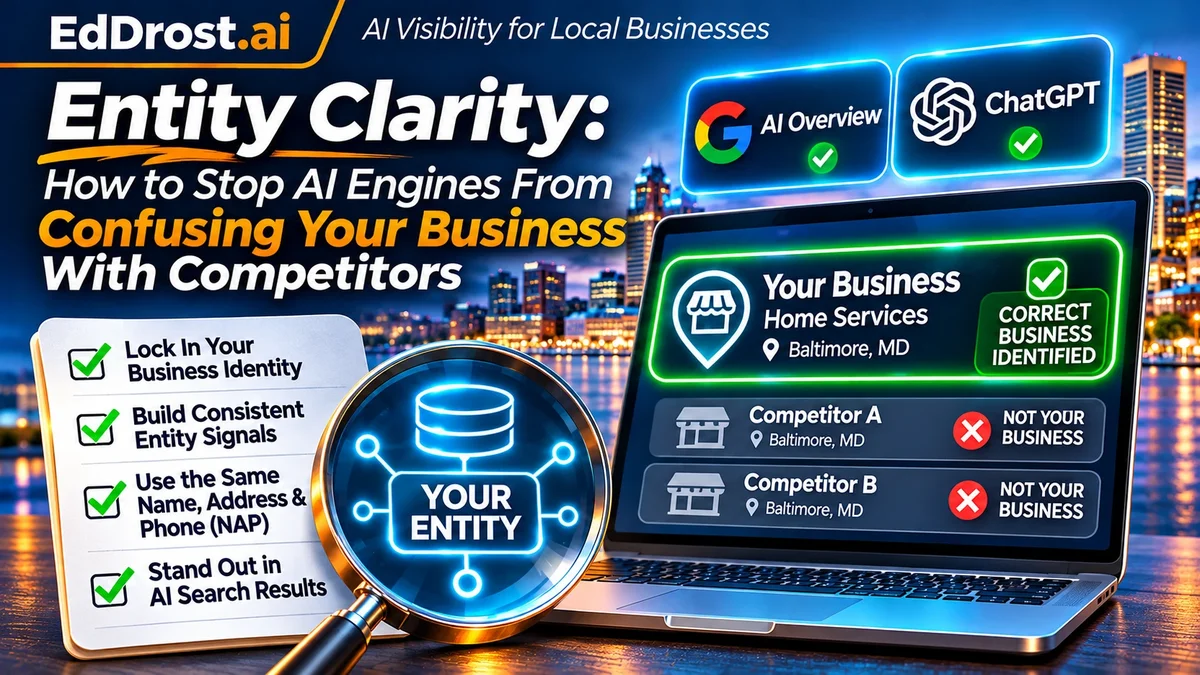
Entity clarity is the practice of making your business's identity, leadership, services, and service area unambiguous to search engines and large language models. When a local business uses inconsistent names, outdated addresses, or vague service descriptions across the web, AI engines either confuse it with similarly named competitors or omit it entirely from recommendations.
Traditional search engines operated like sophisticated word-matching indexes: if a user typed "Maryland residential appraiser" and your webpage repeated that phrase in the title tag and H1 headline, Google ranked the URL.
Generative AI engines, including Google AI Overviews, ChatGPT, Perplexity, and Microsoft Copilot, do not simply index strings of words. They map entities: real-world organizations, individual specialists, physical locations, credentials, and the verified relationships connecting them inside knowledge graphs.
Before an AI assistant recommends your business to a prospect in Baltimore, Towson, or Bel Air, it checks whether your business looks like a single, distinct, trustworthy entity. If your website header displays one brand name, your Google Business Profile uses an old DBA, your Maryland state license lookup shows an old office suite, and your founder's name is buried on an undated sub-page, the model's confidence drops.
In generative search, ambiguity equals invisibility, or worse, the AI merges your hard-earned reputation with a similarly named competitor across town. Understanding what AI visibility truly requires starts with locking down entity clarity before you write another blog post. (It is the practical companion to entity grounding.)
How AI engines confuse local businesses with competitors
Consider a common scenario across central Maryland. Suppose a contracting firm operates under the legal name "Chesapeake Bay Restoration & Remodeling, LLC", markets itself on yard signs as "CBR Home Pros", and previously ran under "Chesapeake Exterior Services" five years ago. Meanwhile, two other companies operate within twenty miles: "Chesapeake Bay Remodelers" in Anne Arundel County and "Chesapeake Home Restoration" in Harford County. (All of these names are invented for illustration.)
When a homeowner asks ChatGPT or Google's AI Mode, "Tell me about Chesapeake Bay Restoration in Baltimore. Are they licensed and what do they specialize in?", the model retrieves conflicting records:
- Your website lists your current Parkton or Timonium address, while an unmanaged Yelp page still shows an old warehouse on Pulaski Highway.
- Your Google Business Profile lists "Water Damage Restoration", while your website emphasizes "Kitchen and Historic Rowhome Remodeling".
- Your Maryland Home Improvement Commission (MHIC) license number is printed inside a low-resolution JPEG badge in your footer that text crawlers cannot read.
Faced with contradictory signals and overlapping competitor names, the AI model either hedges with a vague, non-committal summary or cites the competitor whose digital footprint resolves cleanly to a single entity.
The four pillars of local entity clarity
Eliminating entity confusion does not require expensive enterprise software. It requires disciplined alignment across four structural anchors:
| Entity pillar | What creates confusion | How to lock in unambiguous clarity |
|---|---|---|
| 1. Canonical NAP+W | Mixing legal LLC names, abbreviations, old suite numbers, or tracking phone numbers across directories | Standardize one exact Name, Address, Phone, and Website URL character-for-character across every owned and third-party profile |
| 2. Named principal & credentials | Anonymous "Our Team" pages with license numbers trapped inside images | Publish a dedicated principal bio page displaying full name, years of experience, and state license/registration numbers in plain HTML text |
| 3. Explicit sameAs schema | Leaving search engines to guess whether your LinkedIn, GBP, and BBB profiles belong to the same firm | Embed JSON-LD LocalBusiness schema with a sameAs array linking directly to every official profile and licensing registry |
| 4. Sharp specialty boundaries | Claiming to do "everything for everyone" across all of Maryland | State your primary specialties, ideal property types, and core county boundaries in clear, declarative opening sentences |
1. Establish a single source of truth for core facts (NAP+W)
Choose one canonical presentation of your business name, physical address, primary phone number, and primary domain, and enforce it everywhere:
- Website footer & contact page: place your full legal/brand name, street address, direct phone line, and email in crawlable HTML text on every page.
- Core maps & search ecosystems: audit Google Business Profile, Bing Places, and Apple Business Connect so every field matches your website character-for-character.
- Primary industry & regional directories: update Better Business Bureau, Chamber of Commerce listings, and trade-specific directories (such as Avvo, Healthgrades, or Houzz) so legacy DBAs and disconnected phone numbers are retired.
2. Tie expertise to a named human principal
AI engines weigh accountability heavily, especially in regulated or high-trust local categories like real estate valuation, legal counsel, healthcare, financial planning, and licensed trades. Anonymous corporate copy struggles to earn citations. Create a thorough About page for the business owner or lead specialist that explicitly documents:
- Full legal name and professional designation
- Exact state license or certification numbers in plain text (for example, Maryland Certified Residential Appraiser, License #30004874)
- Years of active local field experience and specific counties served
- Direct links to published articles, case studies, and external media appearances
In our 72-hour Baltimore case study, pairing a 37-year state license credential directly with hyperlocal neighborhood content gave Google's retrieval systems clear verification that a real, accountable local expert stood behind the domain.
3. Connect your footprint with sameAs JSON-LD schema
Even when your profiles share the same business name, search crawlers benefit from explicit machine-readable confirmation. Inside your homepage LocalBusiness or ProfessionalService JSON-LD block, include a sameAs property containing the exact URLs of your:
- Google Business Profile share link
- LinkedIn company page and founder profile
- YouTube channel or podcast feed
- Better Business Bureau and state licensing board verification pages
This structured handshake sits at the foundation of the 24-Signal Authority Method, ensuring that every review, video, and directory listing feeds authority back into one unified entity node. For the markup itself, see Schema Markup for Local Businesses.
4. Define clear service and geographic boundaries
Ironically, claiming to serve every customer in every town weakens your entity profile. When a firm lists 25 unrelated services across the entire Mid-Atlantic, AI models cannot classify what you are actually known for. State your boundaries explicitly in plain language:
- Core focus: "We specialize in retrospective estate, divorce, and pre-listing residential appraisals. We do not perform commercial industrial valuations or home inspections."
- Core territory: "Serving Baltimore City, Baltimore County, Harford County, and Carroll County."
Clear boundaries make it effortless for ChatGPT and Google AI Overviews to match your business to high-intent buyers who fit your exact profile.
The 15-minute entity clarity self-audit
Run these four checks this week to spot entity leaks before they cost you referrals:
- Run an identity prompt in two AI engines. Open ChatGPT and Google Search (AI Mode) and ask: "Who owns [Your Business Name] in [Your City], what are their credentials, and what services do they specialize in?" Flag any missing license numbers, wrong cities, or blended competitor details.
- Inspect your footer and About page source text. Highlight your address, phone number, and license number on your live website with your cursor. If you cannot highlight the text, it is locked inside an image where crawlers struggle to verify it.
- Check your Google Business Profile title and categories. Ensure your GBP business name matches your real-world signage and website header without keyword stuffing, and verify your primary category reflects your highest-value service.
- Verify cross-platform alignment. Confirm that your website, GBP, LinkedIn, and top two directories all reinforce the exact same core entity facts across the Citation Geyser.
When every touchpoint on the web points cleanly to one verified expert, one physical footprint, and one clear specialty, AI engines stop guessing who you are and start recommending you by name. To uncover where your current digital footprint leaves room for competitor confusion, run the Invisible Expert Scorecard or explore more tactical guides in the Insights library.
Frequently Asked Questions
What is entity clarity in local SEO and AI search?
Why do Google AI Overviews and ChatGPT confuse local businesses with similar names?
How does sameAs schema improve local AI visibility?
Experience builds value. AI builds leverage.