The Short Answer
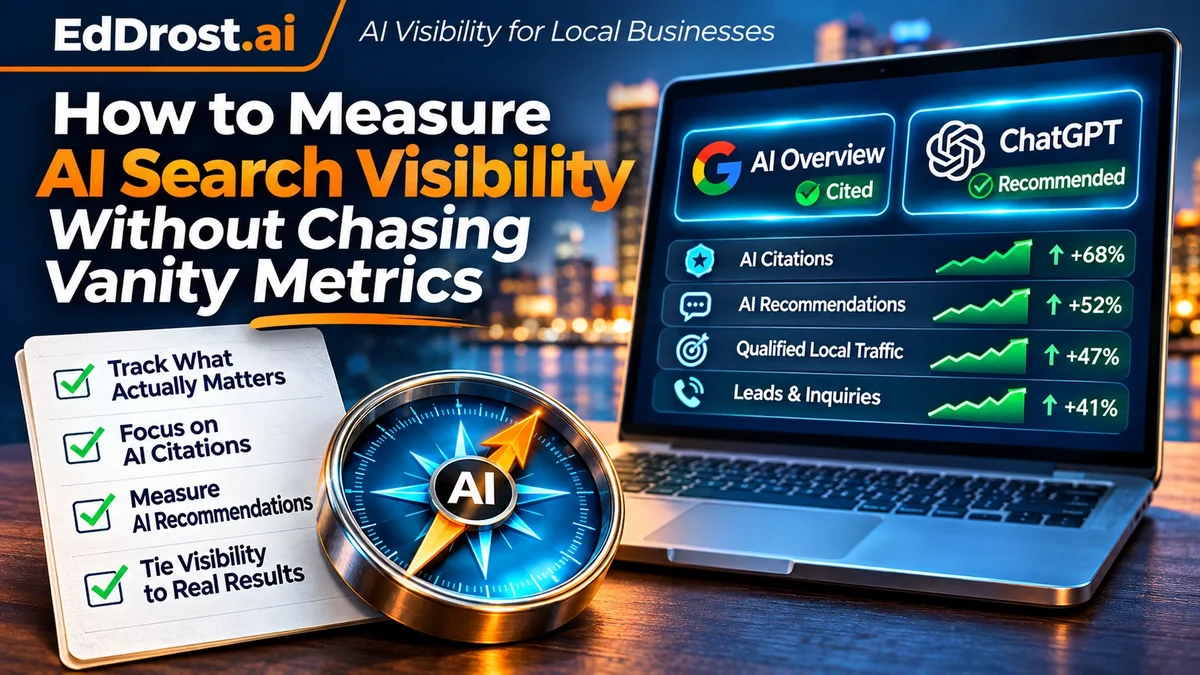
Traditional rank tracking does not work in AI search because generative answers change by phrasing, user location, and session. Local businesses should measure AI visibility using four grounded indicators: citation share across a fixed set of 15–20 real buyer prompts, branded search impression growth in Google Search Console, Google Business Profile direct actions, and qualified inbound leads mentioning AI discovery.
Every week, a new software dashboard promises to track your "AI Rank #1" across ChatGPT, Gemini, and Google AI Overviews, complete with color-coded daily charts that look just like a legacy SEO keyword tracker.
For a local business owner in Baltimore or central Maryland, buying into that metric is one of the fastest ways to waste time and budget.
In traditional Google search, rankings were deterministic enough to track with a daily script: type "estate appraiser Towson MD", check positions 1 through 10, and record whether you moved up or down. Generative AI search does not operate on a fixed list of ten blue links. Run the exact same local service question five times in a row inside ChatGPT or Google's AI Mode, and the wording, the cited sources, and sometimes the recommended companies will shift based on phrasing nuance, session context, and live retrieval passes.
When you measure a probabilistic system with a legacy rank tracker, you end up chasing phantom fluctuations while missing the signals that actually bring in phone calls and signed contracts. Understanding what AI visibility really measures starts with replacing vanity scores with grounded business indicators.
Four tracking traps that mislead local business owners
Before setting up a measurement routine, strip out the four habits that distort how small businesses evaluate AI search performance.
1. Testing prompts real buyers never type
Many owners test their visibility by typing broad, ego-driven queries like "Who is the best HVAC company in Maryland?" or "Top personal injury lawyer Baltimore." Those prompts almost always trigger national lead-generation directories, paid roundup lists, or review aggregators.
Real buyers ask situational, constraint-heavy questions: "Who repairs boiler heating systems in older Roland Park homes?" or "How much does a pre-listing home appraisal cost in Harford County?" If you measure yourself against generic directory prompts, your dashboard will look bleak even when you are winning high-intent local buyers.
2. Treating every single-run omission as an emergency
Because large language models synthesize answers dynamically, being cited in four out of six test runs and omitted in two is normal behavior, not a ranking penalty. Reacting to a single test run by rewriting your homepage every Tuesday destroys entity stability. Measure patterns across a 30-day window rather than obsessing over daily spot-checks.
3. Confusing zero-click AI answers with zero business impact
Legacy SEO trained owners to equate website sessions with success. In AI search, a prospect often gets their core questions answered directly inside the Google AI Overview or ChatGPT response: they see your business name, read that you have 30+ years of local experience, confirm your service area, and then open a new tab to search your brand name directly or dial your phone number.
Your informational blog traffic might look flat or slightly lower while your actual conversion rate climbs. Tracking raw website clicks alone misses the entire middle of the AI buyer journey. (For what to do with that traffic once it arrives, see how to convert zero-click AI search traffic.)
4. Ignoring entity errors in pursuit of "mention counts"
A dashboard that celebrates "12 AI mentions this month!" is useless if ChatGPT is quoting your 2022 pricing, listing an old office address in Timonium, or claiming you do not serve Anne Arundel County. The single highest-ROI output of an AI visibility audit is catching and correcting factual hallucinations before prospects act on them.
The four real metrics of local AI search visibility
Instead of paying for synthetic "LLM visibility scores," track four concrete signals you can verify directly from your own data and monthly testing:
| Measurement pillar | Where to check it | What healthy progress looks like |
|---|---|---|
| 1. Buyer-prompt inclusion rate | A fixed spreadsheet of 15–20 real customer questions tested monthly across Google AI Overviews, ChatGPT, and Perplexity | Your business is named and accurately described in 40%–60% of high-intent local prompts within your core specialty |
| 2. Branded search growth | Google Search Console (Performance → Search Results → filter by brand name) | Steady month-over-month rise in impressions and clicks for your exact company name and principal's name |
| 3. GBP high-intent actions | Google Business Profile (Performance → Calls, Website Clicks, Direction Requests) | Increasing direct phone calls and website taps from local map and AI-assisted searches |
| 4. Intake attribution | Phone intake logs and website contact forms ("How did you hear about us?") | Prospects stating "I saw you in Google's AI summary," "ChatGPT recommended you," or "I researched options online before calling" |
Why branded search is your best proxy for AI discovery
When an AI engine cites your firm as the local authority, buyers rarely click the tiny footnote link blindly. Instead, they run a quick verification search for your exact business name (for example, "Baltimore's Trusted Appraiser" or "Ed Drost Baltimore") to check your Google reviews and phone number before calling.
A steady climb in branded impressions inside Google Search Console, paired with stable or growing phone inquiries, is the clearest practical evidence that off-site AI mentions are driving real buyer intent. It is a proxy, not proof, so read it alongside your intake notes.
How to run a 20-minute monthly AI visibility audit
You do not need complex software to track this. Set a recurring 20-minute calendar block on the first Monday of every month and run through four steps.
Step 1: Lock a fixed 15-prompt test sheet
Write down 15 real questions your best clients ask before hiring you, split across three categories:
- 5 problem & cost prompts: e.g., "How much does [service] cost in [Baltimore neighborhood / Maryland county]?"
- 5 comparison & method prompts: e.g., "What is the difference between [Option A] and [Option B] for [local property/situation]?"
- 5 local provider prompts: e.g., "Who handles [specific service] near [Town/ZIP code]?"
Keep the exact wording identical from month to month so you are comparing apples to apples.
Step 2: Test across three engines in clean sessions
Run your 15 prompts in an incognito or logged-out browser window across Google Search (AI Overviews / AI Mode), ChatGPT (with web search enabled), and Perplexity. For each prompt, record only three data points: Named? (Yes/No), Cited URL? (Yes/No), and Facts accurate? (Yes/No).
Step 3: Cross-check Google Search Console and GBP
Open Google Search Console and compare the last 28 days against the previous 28 days for branded queries and non-branded local service queries. Then check Google Business Profile insights for call clicks and website clicks. You can see how these numbers move together in real implementation in our 72-hour Baltimore case study.
Step 4: Turn every visibility gap into one targeted fix
Do not rewrite your whole site based on one monthly audit. Pick the single highest-value prompt where competitors were cited and you were omitted, and diagnose why:
- If AI cited a competitor's pricing or process breakdown: add a clear, answer-first section or comparison table covering that exact question on your service page, structured using the 24-Signal Authority Method.
- If AI stated wrong hours, services, or locations: update your website footer, Google Business Profile, and core directories so every source matches character-for-character.
- If AI cited a third-party directory instead of your site: strengthen your off-site corroboration across the Citation Geyser by collecting fresh, service-specific customer reviews mentioning that exact specialty and town.
Stop measuring impressions. Start measuring citations that convert.
In local business, visibility without accuracy or conversion is just noise. Ranking #1 for a broad keyword that never makes the phone ring does nothing for your bottom line, and obsessing over a fluctuating third-party AI score only distracts you from publishing clear, verifiable expertise.
Track the 15 questions your real buyers actually ask, watch your branded searches and direct calls climb, and fix factual gaps one page at a time. If you want a baseline snapshot of where AI engines currently name, cite, or overlook your business, run the Invisible Expert Scorecard or see how Baltimore professionals structure pages for AI Overviews.
Frequently Asked Questions
Why do traditional keyword rank trackers fail in AI search?
What are the best metrics to measure local AI search visibility?
How does branded search volume show AI Overview performance?
Experience builds value. AI builds leverage.