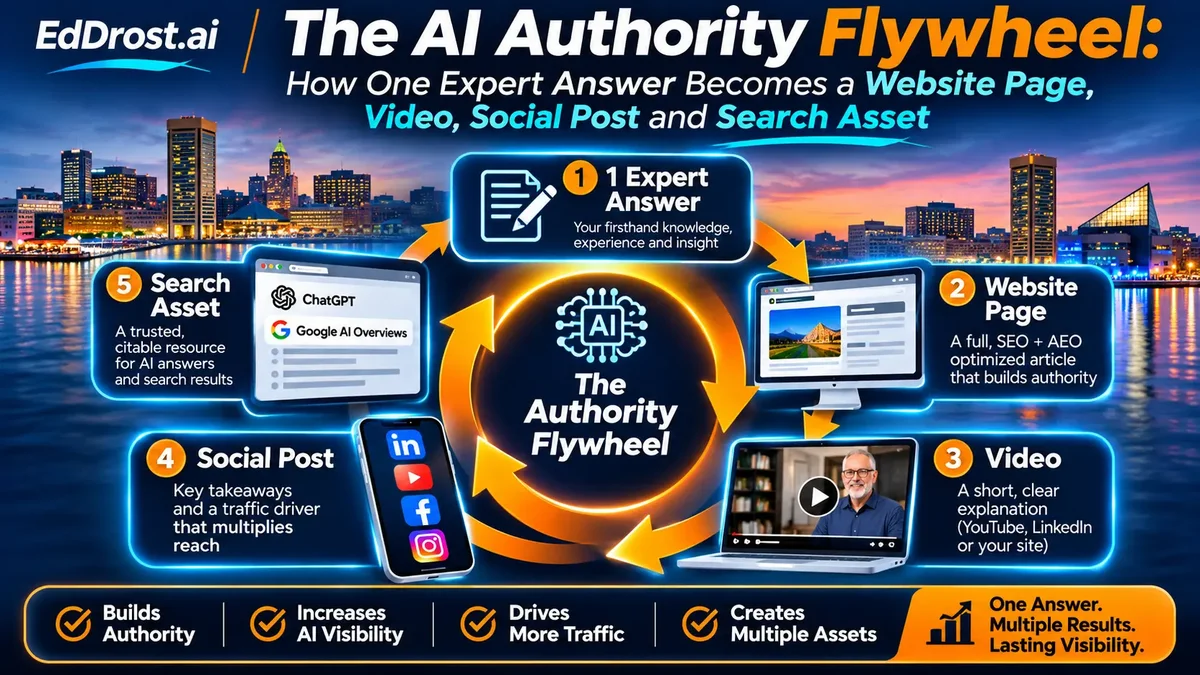
The Short Answer
An AI content distribution strategy turns original expertise into useful content across your website, video, social channels and search-accessible resources. Instead of inventing something new for every platform, you start with one real customer question, build an accurate expert answer, then adapt it to each channel. I call this the AI Authority Flywheel: Capture, Validate, Create, Adapt, Distribute, Measure.
The point isn't to publish the same thing everywhere. It's to turn firsthand knowledge into a set of connected, credible resources that help customers find, understand and evaluate your expertise. When each stage feeds the next, content stops being a weekly scramble for ideas and becomes a repeatable process.
Why most small-business content stalls
Monday, someone says you need more blog posts. Tuesday, a reminder to post on LinkedIn. Wednesday, an expert says YouTube. Thursday, another says short video. By Friday you're wondering when you're supposed to do the work that pays the bills.
That isn't a lack of expertise. It's a production-system problem. A contractor with 25 years in older homes could explain hundreds of problems homeowners run into, but that knowledge lives in conversations, jobsite observations, emails and gut judgment. None of it is organized into assets people can find.
Now imagine recording one ten-minute conversation with that contractor every week. From that, a supervised AI-assisted workflow could help produce an article, a short educational video, a professional post and a customer FAQ. The expert supplies the knowledge. AI helps organize and adapt it. You don't get more content for its own sake. You get more access to expertise that already exists.
The foundation: the 24-Signal Authority Method
I built the 24-Signal Authority Method on one idea: experienced professionals already hold valuable information, and their challenge is making it discoverable and useful online. It has three parts.
- Ten FAQ signals answer what customers already ask. For a Baltimore appraiser: What does a private appraisal cost? How long does it take? What does an appraiser inspect? Why is my Zestimate different from an appraised value? Do I need an appraisal for an inherited property?
- Ten Should-Ask signals reveal what customers don't know to ask. A homeowner asks about price without realizing the effective date of the valuation could be critical. One good Should-Ask answer can be more distinctive than five generic blog posts.
- Four Authority Anchors give the content a credible base: Your Story (the authentic background behind your experience), Your Framework (a clear, teachable method), Your Proof (verifiable projects, evidence and credentials) and Your Offer (a clear next step for someone who needs help).
The signals are a planning system, not 24 guaranteed ranking factors. They don't require 24 separate articles either. A signal can live in an existing page, a section, a video or a supporting resource. The goal is thoughtful coverage, not volume.
How the flywheel works
A flywheel gains momentum when each turn makes the next one easier. Here, every good expert answer becomes the base for several related assets.
Stage 1: Capture the expert answer
Start with one real customer question, not fifty trending headlines from an AI tool. Say it's: "Does remodeling a kitchen increase the appraised value of a Baltimore home dollar for dollar?" I can answer that from decades of valuation work, but the first step isn't writing an article. It's capturing the reasoning. I'd record myself answering five follow-ups: Does renovation cost equal market value? How do appraisers judge remodeling quality? What role do comparable sales play? Can over-improving limit the return? What should homeowners consider before renovating? Ten minutes of real professional explanation beats any generic AI outline. Capture what the expert knows before asking software to rewrite it.
Stage 2: Validate
Separate firsthand judgment from claims that need outside verification. For an appraisal article, that means confirming references to professional standards, checking market examples, and making sure no confidential assignment information slips out. A health business has to check claims against appropriate evidence. A contractor should verify local permit requirements. AI can help with research and drafting. It should never invent projects, credentials, numbers or testimonials.
Stage 3: Create the primary website resource
Build the authoritative page first. For the kitchen question: "Does a Kitchen Remodel Increase Your Baltimore Home's Appraised Value? What Actually Matters." Include a direct answer, cost versus market value, your methodology, properly supported local examples, common misconceptions, FAQs and a clear next step. Publish it on your own domain. That page becomes the central resource everything else points back to, so you're not depending entirely on a social platform.
Stage 4: Adapt
Now the flywheel earns its keep. The article is your verified foundation. Each format has its own job:
- Website article: the thorough explanation with supporting evidence.
- YouTube video: you explaining it in a conversational, visual way.
- Short-form video: one takeaway in about 30 to 60 seconds.
- LinkedIn post: one professional insight, misconception or lesson.
- Google Business Profile post: a brief, locally relevant takeaway where that feature is available.
- Email or newsletter: a summary for subscribers with a link to the full piece.
These shouldn't be identical copies. They share the same verified facts, shaped for different audiences.
Stage 5: Distribute and connect
Publish where your customers already spend time, then connect the pieces. Embed the video in the article. Link to the article from the video description. Reference the explanation in a LinkedIn post. Let the newsletter point to the guide. You're not trying to force an AI engine to cite you. You're giving customers more legitimate ways to run into your knowledge and judge it.
Stage 6: Measure and improve
Watch the page, the video, the posts and the inquiries. Which questions drew qualified visitors? Which explanations started real conversations? Did the video surface a new customer question? What did people misunderstand? Those answers are the input for the next cycle.
One appraisal answer, six assets
Question: does a kitchen remodel raise appraised value dollar for dollar? Expert answer: not necessarily. Cost and market value are different things. An appraiser looks at how the market responds to the improvement: the property's condition, quality, utility, location and relevant comparable sales. From that one answer:
- SEO article: "Does a Kitchen Remodel Increase Appraised Value in Baltimore?" with examples, valuation considerations and homeowner FAQs, linking to related guides.
- Two-minute YouTube video: "Does a $40,000 Kitchen Remodel Add $40,000 to Your Home's Value?" It uses a simple hypothetical. The $40,000 is an illustration, not a promised return or a documented local result.
- 45-second short: "Thinking about spending $40,000 on a new kitchen? Don't assume your home's value goes up by $40,000." Then one point: buyers and comparable sales set the market reaction, not the homeowner's invoice.
- LinkedIn post: a professional observation on construction cost versus contributory value, inviting thoughtful questions without promising an appraisal result.
- Google Business Profile post: a short, locally relevant answer with an image and a link to the full article.
- Newsletter feature: "Before You Remodel Your Kitchen, Understand This Valuation Mistake."
The insight stays the same. The length, presentation and next step change with the channel. That's what repurposing should look like.
Why it can help SEO, AEO and AI visibility
Google's current guidance stresses original, useful, experience-based content for both traditional Search and its generative AI features. A site with detailed professional explanations can be more useful than one with interchangeable summaries. Distribution adds something different: more legitimate ways to be discovered. A customer might meet you in a short video, search your company later and read your service page. Another finds the article straight from Google. A third sees it cited in an AI answer.
Video has its own technical requirements. Google publishes guidance on video indexing, such as accessible watch pages, suitable thumbnails and supported structured data, and YouTube supports chapters and timestamps. Those practices can help video discovery. They don't guarantee rich results.
One caution. Publishing the same answer on six platforms does not automatically multiply your odds of being cited. There's no verified rule that one article plus one video plus one social post equals three authority signals. The opportunity is broader discoverability, not guaranteed algorithmic influence. And keep your identity consistent, so a reader can connect the professional, the company, the content and the service without any invented endorsements. I wrote about that in Entity Clarity.
A weekly workflow
| Day | Main task | Output |
|---|---|---|
| Monday | Choose one customer question and record your expert answer | Original answer and source notes |
| Tuesday | Research and develop the primary article | Reviewed website draft |
| Wednesday | Record and edit the video | Full video and a short clip |
| Thursday | Adapt for professional and local channels | LinkedIn post, Business Profile post, newsletter |
| Friday | Publish, connect and verify | Live links and updated tracking |
That's an illustrative schedule, not a promise that every professional can finish it in a fixed time. The first few cycles run longer while you build templates and standards. The aim is fewer repeated decisions, so you spend your time contributing judgment instead of rebuilding the same information for every platform.
Where AI helps, and where it doesn't
AI is useful for organizing interview transcripts, spotting unanswered follow-up questions, drafting outlines, adapting source material into other formats, creating first-pass video scripts, suggesting descriptive headings, comparing content against a checklist and preparing metadata. But the professional keeps responsibility for important claims. AI should not invent a successful project, manufacture a customer quote, or claim a measured search result without data. Before anything goes out, I check four things:
- Accuracy: are the facts and examples right?
- Evidence: can the important claims be backed up?
- Consistency: do the assets say the same essential thing?
- Usefulness: does each format help its audience?
Human review matters most in regulated professions, health topics, financial services and anything legal or tax-related. AI should amplify professional knowledge, not impersonate professional experience.
Repurposing is not spam
Repurposing isn't pasting the same paragraph on every site. It isn't generating 25 near-identical articles because a tool can do it in minutes. Useful repurposing changes the presentation to fit the context: an article explains a complicated decision, a short video shows one consideration, a post starts a discussion, a newsletter helps an existing audience apply the lesson. Google warns against producing large amounts of low-value content mainly to manipulate rankings, including content that looks extensive but adds little originality. My rule: create once from real expertise, adapt thoughtfully, publish selectively. Not every question needs every format.
How to measure it
Don't measure by how many pieces you publish. You could post 40 times a month and never get a qualified inquiry. Track three layers:
- Production: expert questions documented, primary articles published, videos created, supporting content distributed, existing resources meaningfully improved.
- Discovery: organic impressions and clicks, qualified visits to service and article pages, video views and relevant engagement, newsletter clicks, observed AI mentions and citations.
- Business: qualified inquiries, consultation requests, calls, new customers, and contribution profit where attribution is reasonable.
Keep those layers separate. A social impression is not a website citation, and neither one is a paying customer. As an illustrative monthly target: one original expert answer a week for four weeks could yield four primary articles, four short videos, four LinkedIn posts, four Business Profile updates and four newsletter features, 20 assets from four answers, if every format is relevant and you can hold the quality. Those are production targets, not measured results. The lasting value is four substantial website resources that keep helping customers after publication week.
A 30-day launch plan
- Week 1, build your expertise inventory. Collect ten real customer FAQs, identify ten Should-Ask questions, review the four Authority Anchors, and choose four questions to develop first.
- Week 2, build the first complete package. Record one expert answer, write the primary article, make one educational video and two supporting formats, and check the facts.
- Week 3, publish and connect. Publish the article, distribute the video and supporting content, link related resources naturally, and check that everything loads and the links work.
- Week 4, measure and improve. Review search performance, video engagement and inquiries, record the new questions customers raised, and fix the weakest part of the process before you increase volume.
The first month is for building a reliable rhythm, not for producing the most posts possible. If you haven't yet set a baseline for what you're measuring, the 20-step checklist and the break-even calculator are good places to start.
Your expertise is the source
After 37 years of residential appraisal around Baltimore, I've had thousands of conversations and learned how people make big property decisions. For a long time most of that stayed inside individual assignments. AI gives me a way to organize and share it more efficiently. But the value doesn't come from the AI. It comes from the experience. One expert answer becomes an article. The article becomes a video. The video becomes a short explanation. The explanation becomes a conversation, and that conversation may reveal the next important customer question. The flywheel doesn't create your expertise. It helps more people benefit from it.
Ready to turn your experience into a repeatable system? Read how the 24-Signal Authority Method works, or start with the Invisible Expert Scorecard.
Frequently Asked Questions
What is an AI Authority Flywheel?
Does publishing on multiple platforms improve AI citations?
Should I publish the article or the video first?
Can AI create all the content automatically?
Is the 24-Signal Authority Method the same as creating 24 articles?
How often should a small business publish?
Experience builds value. AI builds leverage.