The Short Answer
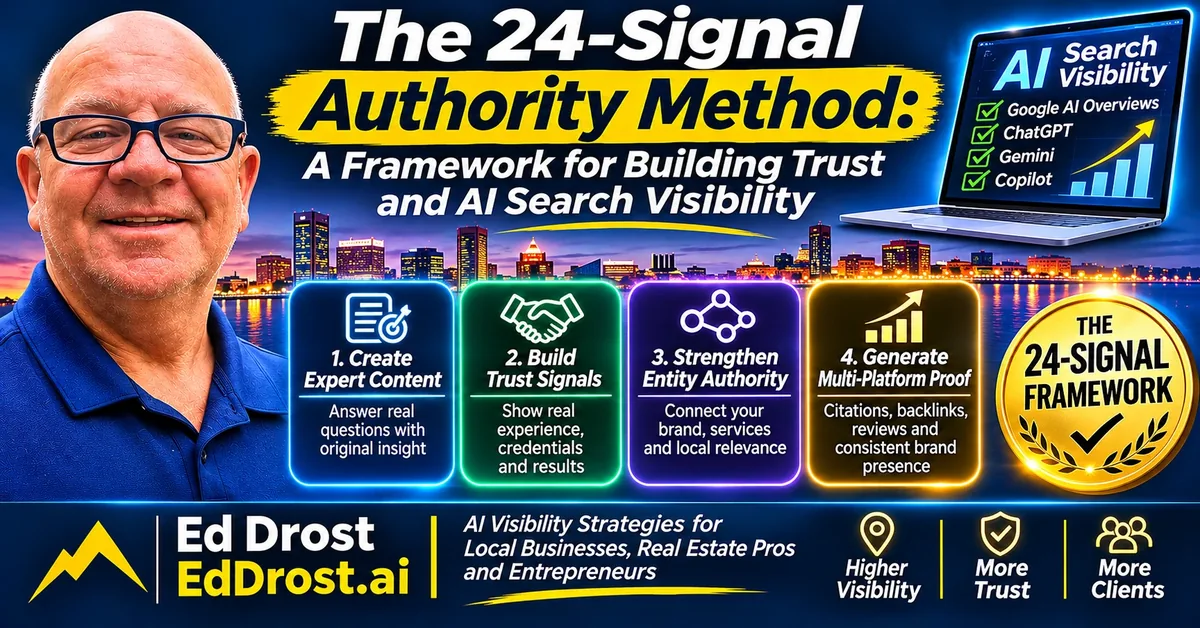
The 24-Signal Authority Method is my content planning framework for experienced professionals. It breaks an authority footprint into 24 pieces: 10 FAQ signals (questions people already ask), 10 Should-Ask signals (questions they should be asking), and 4 Authority Anchors (Your Story, Your Framework, Your Proof, and Your Offer). The numbers are part of my framework. They are not official search engine ranking factors.
This article is a build guide. If you want the concept first, start with how the method works or the one-page 24-Signal Grid.
Why I Built a Framework at All
Experienced professionals rarely have a shortage of knowledge. They have a shortage of structure. Thirty years of insight sits in your head and in scattered emails, and a website says "Contact us."
I needed a way to turn my own 37 years of appraisal experience into something readers and search tools could actually find and check. I needed a finish line, too, because "publish more content" has no end. Twenty-four is a number I can plan around. It is a planning device, not a magic number.
The Three Parts
Ten FAQ signals: the demand layer
These are the real questions your best prospects already ask. Each one gets a page or section that opens with a complete answer, includes a specific fact, and lives on your own site.
Ten SAQ signals: the expertise layer
These are the Should-Ask Questions only your experience can answer. They show what separates you from a generic source.
Four Authority Anchors: the trust and conversion layer
- Your Story: how you built your expertise, written plainly and honestly.
- Your Framework: a named method that explains how you think and work.
- Your Proof: real numbers, cases, and credentials, with their limits stated.
- Your Offer: the clear next step for a qualified visitor.
A Worked Example: An Estate Appraisal Practice
Here is how I would start the grid for a specialty in my own field. These are illustrations of the kind of content, not finished pages.
| Layer | Example signal |
|---|---|
| FAQ | What is a date-of-death appraisal? |
| FAQ | Who orders an appraisal for an estate, and when? |
| FAQ | What does an estate appraisal include? |
| SAQ | What date does the value need to reflect, and who decides? |
| SAQ | What happens if the property was changed after the date that matters? |
| SAQ | Which questions should I raise with the estate's attorney or tax professional before ordering? |
| Anchor 1: Story | Appraising in the Baltimore area since September 1989 |
| Anchor 2: Framework | The 24-Signal Authority Method |
| Anchor 3: Proof | The documented case study, with limits stated |
| Anchor 4: Offer | A free diagnostic scorecard, then a consultation |
Notice that the SAQ about the attorney or tax professional points the reader to the right advisor. A good SAQ knows where your expertise ends.
Your Build Schedule
If you can work on this steadily, here is a realistic order. Working alone, plan on four to six weeks. Do not rush quality to hit a number.
- Week 1: The anchors. Write Your Story, name Your Framework, gather Your Proof, and define Your Offer. Everything else points back to these.
- Week 2: The FAQ signals. Write the ten questions your best clients ask most. Lead with the answer each time.
- Weeks 3 and 4: The SAQ signals. Write the ten questions you wish clients had asked sooner. This is where your experience does the heavy lifting.
- Week 5: Connect and publish. Link the pieces together, add author details and sources, and make sure each page has a next step.
- Week 6: Test and measure. Ask real questions on the AI tools your audience uses. Record the results. Check Search Console. Count calls and forms.
Distribution: Do Not Let It Sit on One Page
One signal can become a website page, a short video, a LinkedIn post, a Google Business Profile update, and a newsletter note. I call that routing the Citation Geyser. The idea is simple: publish once on your own site, then repurpose where your audience actually spends time, always pointing back to the source page.
What the Method Is Not
- It is not a ranking formula. Search engines do not score you out of 24.
- It is not a guarantee. No content plan can promise a citation or a client.
- It is not a template to fill with generic text. The value is in the specifics you add.
My evidence is one implementation: the 74-page appraisal site I built, which I reported reached Page 1 and a Google AI Overview citation within 72 hours. It is one case in one market. Read it as a worked example, not a forecast. Details are in the case study.
Mistakes to Avoid
- Starting with the FAQs and never reaching the anchors. The anchors turn visibility into trust.
- Counting pages instead of quality. Twenty-four thin signals are worse than twelve strong ones.
- Making unverifiable claims. Support every number, or leave it out.
- Forgetting the next step. A signal that leads nowhere is just information.
Frequently Asked Questions
What is the 24-Signal Authority Method?
Are the 24 signals official Google ranking factors?
How long does it take to build all 24 signals?
Do I need all 24 signals to start?
The Bottom Line
The 24-Signal Authority Method gives your experience a shape: what people ask, what they should ask, and why they should trust you. Build the anchors, answer honestly, and measure what actually reaches your phone.
Experience builds value. AI builds leverage.