The Short Answer
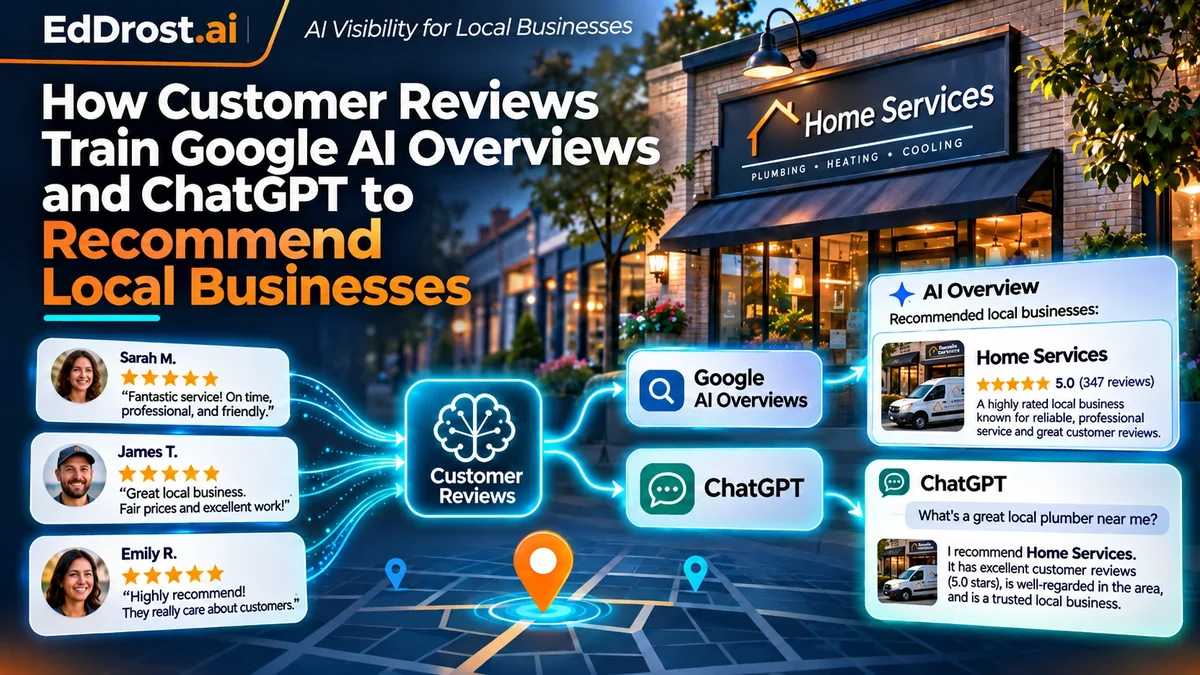
Customer reviews serve as primary real-world verification data for Google AI Overviews, ChatGPT, and Perplexity. Rather than relying solely on star ratings, generative AI models parse review text for specific service names, neighborhood mentions, problem-resolution details, and owner responses. A local business with 40 detailed, service-specific reviews routinely outperforms a competitor with 400 generic five-star ratings in AI recommendations.
For more than fifteen years, local search optimization treated customer reviews as a straightforward volume and rating race. If your business had 4.9 stars across 300 reviews and the competitor down the street had 4.6 stars across 120 reviews, you won the top slot in the Google Map Pack.
Generative AI search has rewritten how that review data gets read, weighed, and cited.
When a homeowner in Towson, Federal Hill, or Bel Air opens Google or ChatGPT and asks, "Who is the most reliable plumber for older rowhome cast-iron pipes in Baltimore?", the model does not simply sort a local database by highest star average. Instead, it runs a multi-source retrieval pass across your website, your Google Business Profile (GBP), and third-party directories to find corroborated real-world proof that your company solves that exact problem.
In that retrieval pass, ten customer reviews mentioning "cast-iron drain replacement," "1920s Baltimore rowhome," and "clean city permit sign-off" carry far greater weight than twenty polished marketing paragraphs written by your own team. Understanding what AI visibility actually requires starts with recognizing that large language models trust what verified buyers say about your work far more than what you say about yourself.
Why star ratings alone no longer win local AI search
Star ratings are quantitative summaries, not qualitative evidence. An AI engine synthesizing a recommendation has to justify why a user should call your firm instead of three other options in the metro area. A bare "5 stars: Great job, very professional!" gives the model zero factual hooks to attach to a buyer's specific question.
Consider how two competing Baltimore-area service businesses appear to an answer engine:
- Business A (high volume, low signal): 380 Google reviews with a 4.9-star average. Nearly all read "Awesome service!", "Highly recommend!", or "Fast and friendly." None mention specific services, property types, or towns.
- Business B (moderate volume, high signal): 48 Google reviews with a 4.9-star average. Thirty-five of those reviews describe the exact problem solved (retrospective estate appraisal, slate roof flashing repair, basement waterproofing in stone foundations), name the neighborhood or county (Roland Park, Canton, Harford County), and note turnaround time or communication clarity.
When a prospect asks an AI engine for a specialist in any of those areas, Business B gets named and cited, even with one-eighth the total review count. In generative search, specificity beats volume.
The four signals AI engines extract from customer reviews
Large language models and Google's AI Overview retrieval systems break review text down into structured entity associations. Every detailed review strengthens four distinct verification signals:
| Review signal | What legacy local SEO looked for | What AI Overviews & LLMs extract |
|---|---|---|
| Service specificity | Keywords stuffed into business descriptions | Exact services named naturally by buyers (e.g., IRS date-of-death valuation, mini-split heat pump install) |
| Geographic context | City name in the GBP address field | Neighborhoods, counties, and local housing or property types mentioned by customers |
| Process & outcome | Overall 1–5 star score | Turnaround speed, pricing transparency, permit handling, and how complications were resolved |
| Owner replies | Basic "Thank you for your business!" templates | Substantive replies that confirm the service performed, reinforce entity expertise, and show active operations |
This is why customer reviews sit at the center of the 24-Signal Authority Method. Your website declares what you do; your schema markup labels those facts for crawlers; and your customer reviews provide the independent third-party confirmation that closes the trust loop.
How Baltimore businesses can engineer better reviews without scripting
Never write reviews for clients, hand them pre-written templates to paste, or offer discounts in exchange for five stars. Beyond violating Google and FTC guidelines, scripted reviews share repetitive phrasing patterns that spam filters and AI quality classifiers discount.
Instead, change when you ask and how you prompt the customer's memory.
1. Ask at peak clarity, not weeks later
Most service businesses send an automated review blast at the end of the month, long after the client has moved on. Send your review request within two hours of completing the milestone: right after you hand over the final appraisal report, finish the final walkthrough, or email the completed inspection photos. At that moment, the exact details of the problem and solution are still top of mind.
2. Use two anchoring questions in your request
A blank review box causes writer's block, which is why busy customers default to "Great service, thanks!" Give them two simple prompts in your follow-up email or text message:
"If you have 60 seconds to share a quick Google review, it helps local homeowners tremendously if you mention: (1) what specific project or issue we helped you with, and (2) which neighborhood or town you're located in."
You are not telling the customer what to say. You are giving them permission to share concrete context. Roughly half of your clients will naturally mirror those two details in their review, turning a one-line compliment into a high-signal local citation.
3. Turn owner replies into indexable entity proof
Leaving reviews unanswered, or pasting the same "Thanks for the 5 stars!" reply fifty times, wastes one of the easiest authority levers on your Google Business Profile. Google indexes owner responses, and AI models read them alongside the original review to verify business activity and specialty scope. Compare a generic reply against an entity-reinforcing reply:
- Generic reply: "Thank you so much for the kind words, Sarah! We appreciate your business."
- Authority reply: "Thank you, Sarah. We're glad we could complete the pre-listing valuation on your Hampden rowhome ahead of your realtor's photography deadline. Wishing you a smooth closing!"
In two sentences, that reply confirms the service (pre-listing valuation), the property type (rowhome), the neighborhood (Hampden), and operational reliability (ahead of deadline), all without sounding robotic or stuffed with keywords.
Mapping reviews across the Citation Geyser
Google AI Overviews draw heavily from your Google Business Profile, while ChatGPT, Perplexity, and Microsoft Copilot cross-reference Google alongside third-party platforms during live web retrieval. Relying on a single platform leaves blind spots when buyers use different AI assistants.
Within the Citation Geyser framework, local businesses distribute review momentum across three tiers:
- Primary anchor (Google Business Profile): 70%–80% of your review requests should go here first, as GBP feeds both Google Maps and Google AI Overviews directly.
- Industry-specific directories: Route 15%–20% of clients to the primary directory that governs your trade, such as Avvo for attorneys, Healthgrades for medical practices, Houzz or Angi for home remodeling, or BBB for residential trades.
- Regional community validation: Encourage satisfied clients who ask for recommendations on Nextdoor or local Baltimore community groups to mention your business by exact name. LLMs frequently ingest public community threads when answering "Who do locals recommend for..." queries.
Common review mistakes that quietly hurt AI recommendations
Even well-reviewed businesses undermine their AI visibility through avoidable operational habits:
- Inconsistent business names across platforms. If your Google Business Profile says "Chesapeake Ridge Home Services LLC" while your Yelp and BBB listings say "Chesapeake Ridge Contractors," AI engines may split your review authority across two separate entities instead of consolidating it. (See Entity Clarity.)
- Letting reviews go stale for six months. Recency matters. Ten steady reviews per quarter signal an active, reliable operation far better than fifty reviews collected three years ago followed by silence.
- Defensive arguments in negative review replies. AI sentiment analysis reads owner responses to 1-star and 2-star reviews to judge professionalism. Calm, factual replies that state how the issue was addressed reassure both human readers and AI models.
The 30-day review upgrade plan for local owners
You do not need expensive reputation software to build an AI-ready review footprint. Start with four concrete steps this month:
- Audit your last 20 reviews. Count how many explicitly name both a specific service and a Maryland town or Baltimore neighborhood. That percentage is your current review signal baseline.
- Rewrite your review request message. Replace generic "Leave us a review" links with a short personal note asking the client to mention the specific work performed and their area.
- Reply to your last 10 unanswered reviews. Write two-sentence responses that naturally confirm the service, location, and outcome.
- Pair reviews with answer-first service pages. Make sure every core service customers praise in your reviews has a dedicated page on your website explaining your process, turnaround time, and local experience.
If you want to see how AI engines currently read your reviews and website together, start with the Invisible Expert Scorecard or explore real Baltimore implementation results.
Frequently Asked Questions
Do Google reviews help local businesses show up in Google AI Overviews and ChatGPT?
Is review volume or review detail more important for AI search visibility?
Do owner replies to Google reviews affect AI search rankings?
Experience builds value. AI builds leverage.