The Short Answer
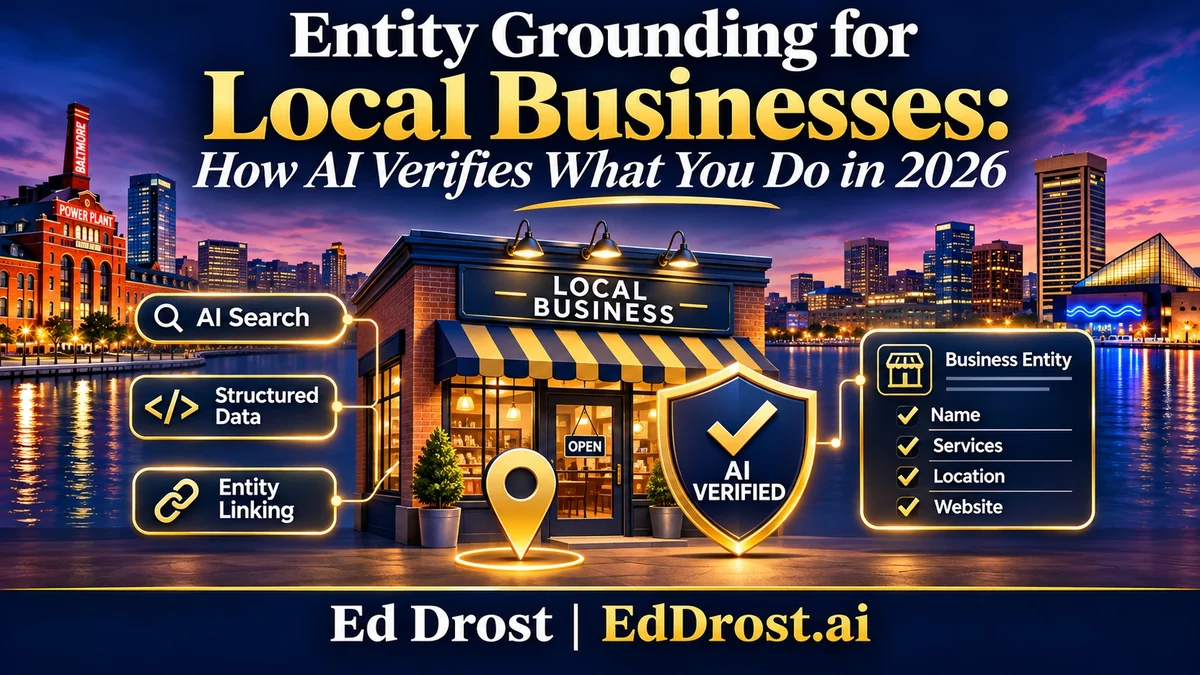
AI engines verify a local service business by matching the same identity facts across trusted sources: your legal business name, state license record, address, phone number, and official profiles connected through sameAs schema. When those facts agree everywhere, the engine can recommend you with confidence instead of guessing.
What entity grounding means in plain English
An entity is a distinct, identifiable thing: a person, a company, a licensed professional. It is the opposite of a string of words on a page. Grounding is the work of tying that entity to records an engine already trusts.
When someone asks ChatGPT, Gemini, or Perplexity for a recommendation, the system is not only matching keywords. It is deciding whether you are a real, specific, verifiable business it can safely name. No engine publishes its exact formula, so nobody outside those companies can honestly tell you the weights. The logic, though, is one every appraiser already lives by.
The appraiser's version: verify the subject before you opine
When I start an assignment, the first job is confirming the subject property: the legal description, the address, the owner of record, the parcel in the SDAT records. If those do not line up, nothing I say about value matters. An engine treats your business the same way. Before it recommends a "Baltimore appraiser," it needs confidence that the thing it is describing is one consistent, real entity.
My own footprint is the worked example. I am a Maryland State Certified Residential Appraiser, License #30004874, and I have been appraising since September 1989, which is 37 years. I operate Residential Appraisal Solutions, LLC under the name Baltimore's Trusted Appraiser, serving Baltimore City, Baltimore County, Carroll County, and Harford County. The discipline is making sure each of those facts appears, identically, in every place an engine might check: the state's public license record, my Google Business Profile, my website's structured data, and my professional profiles. No engine should ever have to choose between two versions of me.
The five grounding checks
- Legal name and brand name. Use your registered name once, and your brand name consistently. In schema, declare the relationship with
legalNameandalternateNameso the engine knows they are the same entity. - Credentials and registration. Your license number should read identically everywhere, with the issuing authority named. A license number is one of the strongest identity facts a licensed professional has, because it exists in a public record the engine can check.
- Name, address, phone. If you work from home or travel to clients, use your service area instead of a street address, and format your phone number the same way on every listing.
- sameAs links. In your JSON-LD, point to your official profiles: your Google Business Profile, LinkedIn, your state license page, and your association or chamber listings. These are the bridges between your website and the records the engine already knows.
- Practitioner identity. Add Person schema for the individual behind the business, with job title, credential, and a link to the organization they work for. Clients hire people, and engines recommend them.
Here is a simplified pattern. The URLs are placeholders; use your real profile addresses.
{
  "@context": "https://schema.org",
  "@type": "ProfessionalService",
  "name": "Your Brand Name",
  "legalName": "Your Registered Business Name, LLC",
  "telephone": "+1-555-555-0100",
  "areaServed": ["Baltimore City", "Baltimore County"],
  "sameAs": [
    "https://www.linkedin.com/in/your-profile",
    "https://www.google.com/maps?cid=YOUR-PROFILE-ID",
    "https://your-state-license-lookup-page"
  ]
}
For a closer look at the markup types worth using, see Schema Markup for Local Businesses: 4 JSON-LD Types Worth Understanding in 2026.
A 30-minute grounding audit
- Search your business name in quotation marks on both Google and Bing. List every page that mentions you.
- Write a one-paragraph master record: legal name, brand name, license number, phone, service area, one-sentence description.
- Compare each listing against the master record. Mark every mismatch, including old phone numbers, retired business names, and wrong service areas.
- Fix the three highest-visibility mismatches first: your Google Business Profile, your website footer, and your main professional profile.
- Add the corrected profile links to your
sameAsmarkup. - Ask ChatGPT, Gemini, and Perplexity: "Who is [your name] in [your city]?" Write down what each says and what it gets wrong. That list is your next to-do list.
What grounding can and cannot do
Grounding removes a reason for an engine to skip you. It does not, on its own, make an engine recommend you. Recommendation still depends on whether your content answers the question better than the alternatives, which is where the 24-Signal Authority Grid and the Should-Ask Questions approach come in. Think of grounding as the foundation: invisible when it is right, expensive when it is wrong.
Frequently Asked Questions
What is entity grounding?
Is NAP consistency still important for AI search?
Do I need schema markup for entity grounding?
How long does it take AI engines to reflect corrections?
The Bottom Line
Grounding is quiet work. When your name, license, and profiles agree everywhere, AI has no reason to hesitate. Start with the master record and the 30-minute audit, then build everything else on top of it.
Experience builds value. AI builds leverage.