The Short Answer
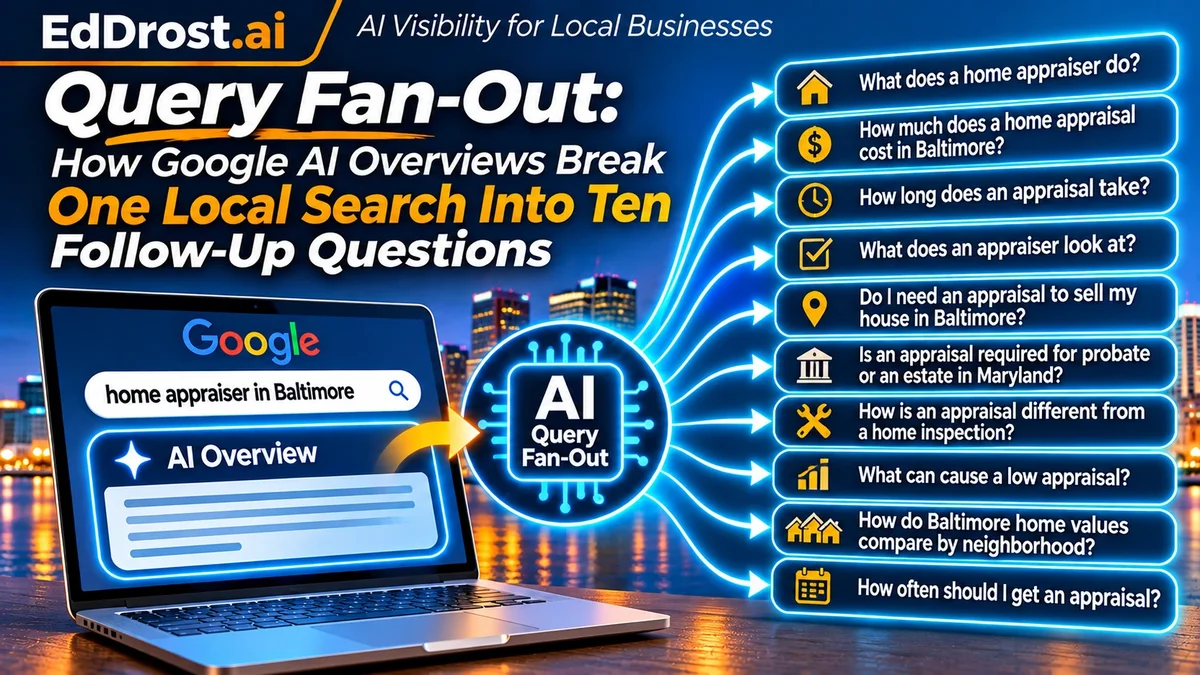
Query fan-out is the process Google AI Overviews and generative search engines use to split a single user prompt into multiple background sub-queries. Instead of matching one keyword, the AI simultaneously searches for pricing, timelines, local regulations, comparisons, and credentials, synthesizing answers from websites that directly address those sub-questions.
For years, local search optimization revolved around a straightforward equation: pick one high-intent keyword, like "pre-listing home appraisal Baltimore" or "historic slate roof repair Towson", build a single service page around that phrase, and work to get that URL onto Page 1.
In Google AI Overviews, Google AI Mode, and ChatGPT Search, ranking for a single head keyword is no longer enough to secure the recommendation.
Behind the scenes, modern generative search engines run a process Google calls query fan-out. When a buyer types one question into the search bar, the AI model decomposes that prompt into multiple distinct, parallel sub-queries, investigating cost, turnaround time, local permits, alternative options, common pitfalls, and provider credentials before writing a single word of its answer. (The exact number varies by query; "five to ten" is a useful planning figure, not a published constant.)
If your website only offers a thin 350-word "Services" page with a generic contact form, Google's retrieval engine will pull your competitor's pricing breakdown, a trade association's comparison chart, and a national directory's timeline, leaving your business completely off the citation card. Understanding what AI visibility requires in 2026 starts with designing content for the entire fan-out tree rather than a single keyword.
How query fan-out works behind the scenes
When a homeowner in Federal Hill, Canton, or Bel Air searches "how much does a pre-listing home appraisal cost in Baltimore", the user sees one clean summary box at the top of the screen. Under the hood, the retrieval engine works through five broad steps:
- Intent decomposition. The model breaks the single prompt into the unstated follow-up questions a prudent buyer needs answered before hiring someone.
- Parallel sub-query execution. It fires multiple narrower searches simultaneously across Google's index and local entity databases:
- What is the average fee for a residential appraisal in Baltimore, MD?
- How long does a pre-listing appraisal take from inspection to final report?
- What is the difference between a realtor CMA and a certified residential appraisal?
- How does an appraiser value renovations in older Baltimore rowhomes?
- Who is a Maryland State Certified Residential Appraiser serving Baltimore City and County?
- Passage-level extraction. Rather than grading whole webpages on keyword density, the system extracts specific, self-contained passages, tables, and bullet lists that answer each sub-query cleanly.
- Cross-source verification. It checks whether the website's claims align with external proof, including Google Business Profile reviews, state licensing records, and third-party citations across the Citation Geyser.
- Answer synthesis & citation. The model stitches the strongest passages into one cohesive response and attaches clickable source links to the pages that supplied the clearest facts.
Notice the major opportunity hidden inside step three: you do not have to rank #1 for the broad head term to earn the AI Overview citation. If your page gives the clearest, most verifiable answer to two or three of those background sub-queries, Google's fan-out engine can pull your passage straight into the synthesized answer.
Why thin service pages lose every branch of the fan-out
Most local small business websites fail during query fan-out because they hide the exact operational facts AI engines look for:
- Vague pricing. Writing "Every project is unique, call us for a custom quote!" forces the AI to cite a national directory like Angi or HomeAdvisor that actually publishes Maryland cost ranges.
- Missing timelines. Failing to state whether a job takes 48 hours, two weeks, or three months leaves an empty branch in the fan-out tree.
- Zero comparison context. Buyers constantly weigh trade-offs (repair vs. replace, flat-fee vs. hourly, tax assessment vs. market value). When your site refuses to compare options objectively, the AI pulls from an informational publisher instead of a local provider.
- No insider risk guidance. Buyers rarely know the regulatory or technical traps specific to their property until something goes wrong.
This is precisely why the 24-Signal Authority Method pairs baseline FAQs with Should-Ask Questions (SAQs), anticipating the exact follow-up branches an AI engine generates on behalf of a cautious buyer.
Mapping a local service into a fan-out cluster
To capture multiple branches of a query fan-out without violating Google's scaled-content spam policies, do not spin up twenty thin, repetitive micro-pages for every phrasing variation. Instead, build one authoritative hub page supported by tightly scoped, deeply useful sections and linked sub-guides.
| Fan-out branch | Sub-query the AI runs | Best on-page format | Baltimore / Maryland example |
|---|---|---|---|
| 1. Cost & drivers | "What does [Service] cost in Baltimore, and what changes the price?" | Bullet list of 4–5 concrete cost factors with realistic ranges | "Standard single-family residential appraisals in central Maryland typically range from $450 to $650, with adjustments for multi-acre acreage in northern Baltimore County or complex historic rowhome renovations." |
| 2. Timeline & sequence | "How long does [Service] take from start to finish?" | Numbered 4-step workflow with exact turnaround windows | "1. Scope & scheduling (24 hrs) → 2. On-site measurement & inspection (45–60 min) → 3. Comparable sales analysis (2–3 days) → 4. Signed PDF delivery." |
| 3. Option comparison | "Is [Option A] or [Option B] right for my situation?" | Compact 3-column HTML comparison table | Comparing a Realtor CMA vs. a certified pre-listing appraisal across methodology, legal admissibility, and cost. |
| 4. Local constraints | "Are there Baltimore or Maryland rules I need to know?" | Short 100-word local context block | Addressing Baltimore City CHAP historic district rules, ground-rent redemptions, or Harford County well-and-septic requirements. |
| 5. Should-Ask risk | "What mistakes cause delays or extra fees?" | Dedicated H3 question + direct 3-sentence fix | "What happens if unpermitted basement square footage is discovered during a pre-listing inspection?" |
The price range in branch 1 is the kind of specific, first-hand figure that earns citations. Use your own current numbers, and keep them updated.
Four rules for writing passage-ready content
Because AI Overviews quote individual passages rather than entire webpages, how you format each section matters just as much as what you write.
1. Write headings as real buyer questions
Replace clever, abstract subheadings like "Our Seamless Process" or "Peace of Mind Pricing" with concrete H2 and H3 questions: "How Long Does a Residential Estate Appraisal Take in Maryland?" Clear question headings act as direct semantic signposts for fan-out retrieval.
2. Front-load the direct answer in 40 to 60 words
Immediately beneath every H2 or H3 question, deliver the complete, standalone answer in two or three plain sentences before expanding into nuance or edge cases. When an AI model extracts that block, it reads cleanly without needing surrounding paragraphs for context.
3. Use HTML tables and numbered lists deliberately
Generative parsers extract structured tables and ordered lists reliably. Whenever a sub-query involves comparing two approaches, checking eligibility criteria, or following sequential steps, structure that information as a clean table or numbered list rather than burying it inside dense prose.
4. Anchor every claim in field proof
Anyone can summarize generic industry definitions. What earns repeated citations across Google AI Overviews and ChatGPT is specific, first-hand operational proof: real turnaround benchmarks, local municipal nuances, and documented outcomes like those shown in our 72-hour Baltimore case study. (This is the same idea behind information gain.)
Turning one service page into a multi-branch citation engine
Audit your highest-margin service page this week by running your core buyer question in Google's AI Mode or ChatGPT and inspecting the sources cited in the footnote cards. Look at what each cited page contributed: one likely supplied the price range, another supplied a comparison table, and a third supplied local credentials.
Add those missing branches directly onto your own hub page, with realistic numbers, clear timelines, a compact comparison table, and two or three local Should-Ask Questions. When your domain answers the entire fan-out cluster in one well-structured place, AI engines no longer need to stitch together five competing websites, and your business becomes a stronger candidate for the primary source. To map your exact content gaps across Google and ChatGPT, start with the Invisible Expert Scorecard or explore more implementation guides in the Insights library.
Frequently Asked Questions
What is query fan-out in Google AI Overviews and AI Mode?
Can a local business get cited in an AI Overview without ranking #1 for the main keyword?
Should businesses create separate pages for every query fan-out variation?
Experience builds value. AI builds leverage.