The Short Answer
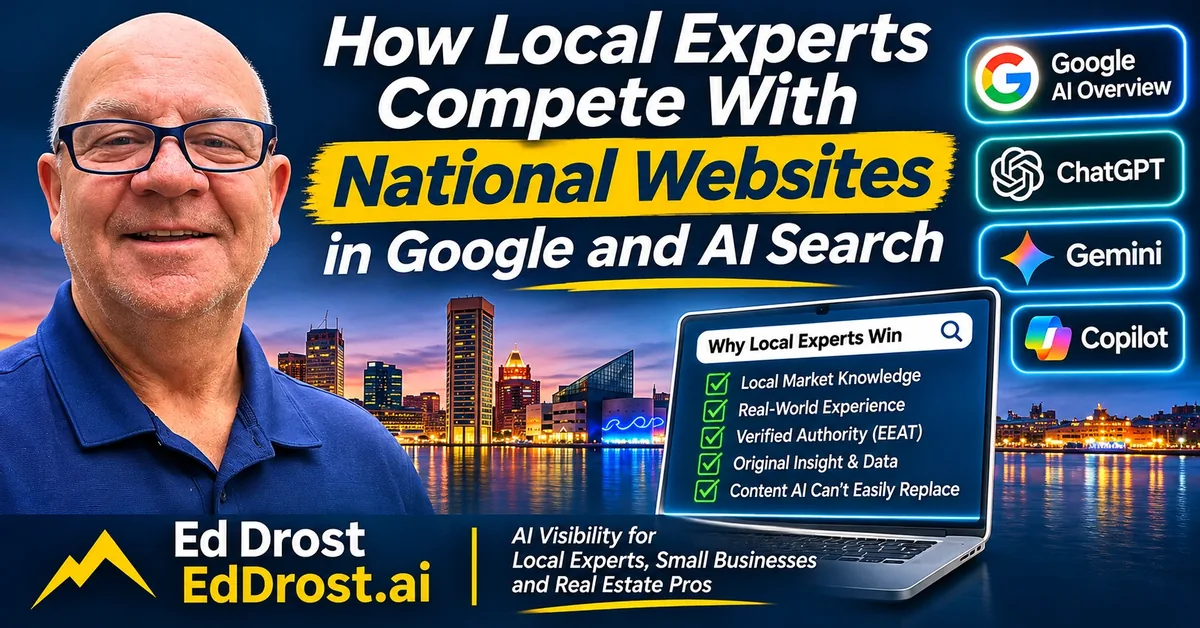
Local experts compete with national websites by publishing what national sites cannot: block-level knowledge, local rules and processes, firsthand case experience, and a verifiable professional identity. National sites win on scale. You win on specifics and accountability. No one can guarantee how a search engine or AI tool will treat either, but specifics give it something real to work with.
The Problem I Know Best
When a Baltimore homeowner asks an AI tool what a house is worth, the answer tends to lean on national averages and automated estimates. Those tools have no eyes on the street.
They do not know that a rowhouse in Canton and one a short distance away in Butchers Hill can be different markets. They do not know whether the alley parking behind a house helps or hurts the value on that particular block. They may not know that a property carries a historic tax credit through CHAP, which can change what a buyer is really paying to own the place.
I have been appraising in the Baltimore area since September 1989. I know these things because I have walked these blocks and worked these assignments, not because I read about them.
That gap between a confident national answer and a correct local one is the opening for every local expert, in every field.
Where National Websites Are Strong, and Where They Are Thin
| National website | Local expert | |
|---|---|---|
| Scale and brand | Very strong | Limited |
| General explanations | Strong, often well written | No advantage |
| Block-level detail | Thin or missing | Your home field |
| Local rules and process | Often generic | Learned by doing |
| Named, accountable person | Rare | Yes, with a license and a face |
| Real case experience | Hard to show | Your best asset |
Do not try to beat a national site at the general explanation. You will lose. Compete on the rows where you are the only one who can answer.
The Five Local Advantage Assets
1. Specific local pages
Write pages about the neighborhoods, towns, or districts you actually serve, with details a stranger could not guess. Here is a simple test: swap the city name for another one. If the page still reads fine, it is too generic. Rewrite it.
2. Local rules and process explained plainly
Every field has local procedures: how an appeal works, which office handles what, what a local deadline means. Explain them in plain language and point to the official source. Do not state a rule from memory if it could have changed. Link to the agency and say when you last checked.
3. A verifiable professional identity
License number, years in the field, service area, and an author byline on every article. My Maryland certified appraiser license number is on every page of this site because anyone should be able to check it.
4. Documented local cases
Describe the situation, what you looked at, what you decided, and why. Remove anything that could identify a client. Get permission where it is needed. A real, anonymized case teaches more than a thousand words of general advice.
5. Consistent local signals
Keep your business name, phone, service area, and website identical across your Google Business Profile, your directories, and your own pages. Local reviews and mentions from other trusted local sources help confirm that you are who you say you are.
What I Reported, and What It Means
For my appraisal business, I reported a Page 1 result and a Google AI Overview citation within 72 hours of publishing the site. I believe the hyperlocal specificity helped. I also know it is one case, in one market, and I cannot prove what caused it. I share it as evidence that local specifics are worth building, not as a promise. The full account is in the case study.
A Practical Seven-Day Start
- Day 1: List ten things customers in your area get wrong or do not know.
- Day 2: Pick the one that costs customers the most when they get it wrong.
- Day 3: Write a page that answers it in the first two sentences, then explains with a local example.
- Day 4: Add your credentials, service area, and a link to the official source.
- Day 5: Check that your business details match your Google Business Profile.
- Day 6: Add a clear next step, such as a call or a form.
- Day 7: Ask two or three AI tools the same question and record what they say.
Mistakes to Avoid
- Copying the national playbook. You cannot out-general them.
- Swapping town names on identical pages.
- Stating local rules from memory without checking the official source.
- Hiding behind a company name. People and AI tools both respond to a real, identifiable expert.
Frequently Asked Questions
Can a local business really compete with large national websites in search?
What makes local content valuable to AI search tools?
Is it a good idea to make a separate page for every town I serve?
How do I keep my business details consistent online?
The Bottom Line
A national site can describe a market. A local expert can describe this market, this block, this process, and stand behind it with a license. That is not a small advantage. It is the one that cannot be copied by changing a town name.
Experience builds value. AI builds leverage.