The Short Answer
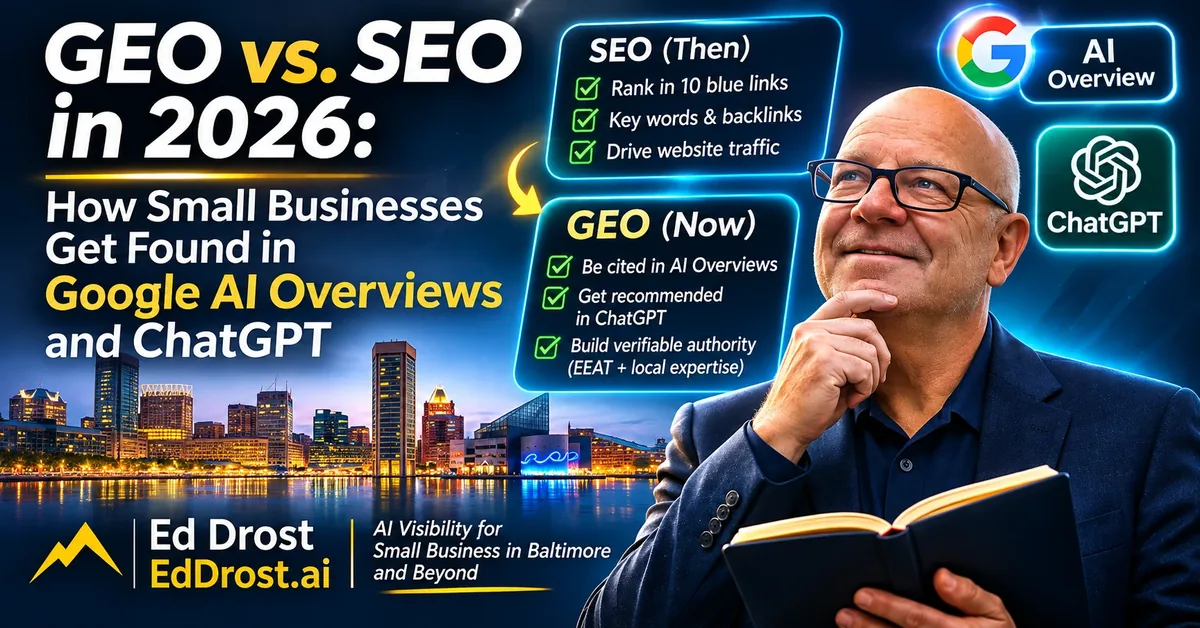
GEO is not a replacement for SEO. It is an extension of it. SEO gets your pages found, crawled, and ranked. GEO (generative engine optimization) asks a second question: when an AI tool builds an answer, is your business a clear, trustworthy source it can draw from? You need the first to have a shot at the second.
Google says as much. Its guidance on AI features states that SEO best practices remain relevant for AI Overviews and AI Mode, and that there are no additional requirements or special optimizations to appear in them.
Why This Question Keeps Coming Up
I started appraising in 1989. Since then I have watched customers go from the Yellow Pages to Google, then to maps and reviews. Every shift brought a wave of people announcing that the old way was dead. It never was. The old way became the foundation, and something new got built on top.
AI search is the same kind of shift. Customers now ask a question and get a written answer, sometimes with a few cited sources. A small business owner naturally asks, "Do I need to start over?"
No. But you do need to understand what each layer does.
SEO and GEO, Side by Side
| Question | SEO asks | GEO asks |
|---|---|---|
| Goal | Can people find my pages in search results? | Can AI tools understand, trust, and reference my business in an answer? |
| Unit of work | The page | The page and the business behind it |
| Strongest levers | Crawlability, relevance, links, speed, mobile | Direct answers, clear identity, original expertise, outside mentions |
| Success looks like | Rankings, clicks | Being cited or named, then earning the click or call |
| Can anyone guarantee it? | No | No |
Notice the last row. Neither one can be guaranteed. Answers vary by tool, by question wording, by location, and by day. Anyone who promises you a placement in an AI answer is selling something.
What Google Actually Says
I read the primary source instead of the hot takes. Google's published guidance on AI features and your website makes a few points worth knowing:
- The SEO basics still apply. Pages must be indexable, useful, and accessible.
- No special schema is required. You do not need a new kind of markup to be eligible for AI Overviews or AI Mode.
- No special AI files are required for those features.
- Structured data should match the visible text on the page, as it always should.
That is a useful dose of reality. If someone tells you a secret technical switch gets you into AI answers, check it against Google's own documentation before you pay for it. Other AI tools, such as ChatGPT search or Perplexity, work differently, and nobody outside those companies can fully inspect how they choose sources. So I treat the unverifiable claims as unverified.
My Two-Layer Plan for Small Businesses
Layer 1: The SEO foundation
- Make sure your key pages are indexed. Check Google Search Console.
- Fix the basics. Mobile-friendly pages, working links, clear titles, fast load times.
- Claim and complete your Google Business Profile if you serve a local area.
- Keep your name, address, phone, and service area identical everywhere they appear.
Layer 2: The GEO layer
- Answer first. Open each key page with a direct, complete answer in the first two or three sentences.
- Say who you are. Name, credentials, license number, years of experience, and service area belong on the page where a reader and a machine can both see them.
- Publish what only you can say. Generic pages blend into the pile. Specific, firsthand knowledge does not.
- Get checked by others. Reviews, professional listings, and mentions on other trusted sites help confirm who you are.
- Test real questions. Ask AI tools the questions your customers ask. Write down what they say about you and whether it is accurate.
How to Tell Whether It Is Working
- Search Console: impressions, clicks, and indexed pages. Google reports traffic from its AI features within overall Web search performance, not as a separate line item.
- A monthly question test: the same five or ten customer questions, run on the same tools, recorded with the date.
- The only number that pays the bills: calls, forms, and booked appointments. Ask new customers how they found you.
One more distinction matters. Being named as a recommendation and being cited as a source are different kinds of visibility. Track them separately.
Mistakes to Avoid
- Abandoning SEO because someone declared it dead.
- Buying a "GEO package" that is mostly keyword stuffing and schema with a new name.
- Treating files like llms.txt as a ranking lever. Google says none are needed for its AI features. They are optional housekeeping at best.
- Publishing generic AI-written pages. If a page could describe any business in any city, it adds nothing.
Frequently Asked Questions
Is GEO the same as SEO?
Do I need special schema markup to appear in Google AI Overviews?
Can I guarantee my business will be cited by ChatGPT or Google AI?
What should a small business do first?
The Bottom Line
SEO is the foundation. GEO is what you build on it so that your real expertise is easy to find, easy to verify, and easy to quote. Do the first well, then add the second.
Experience builds value. AI builds leverage.