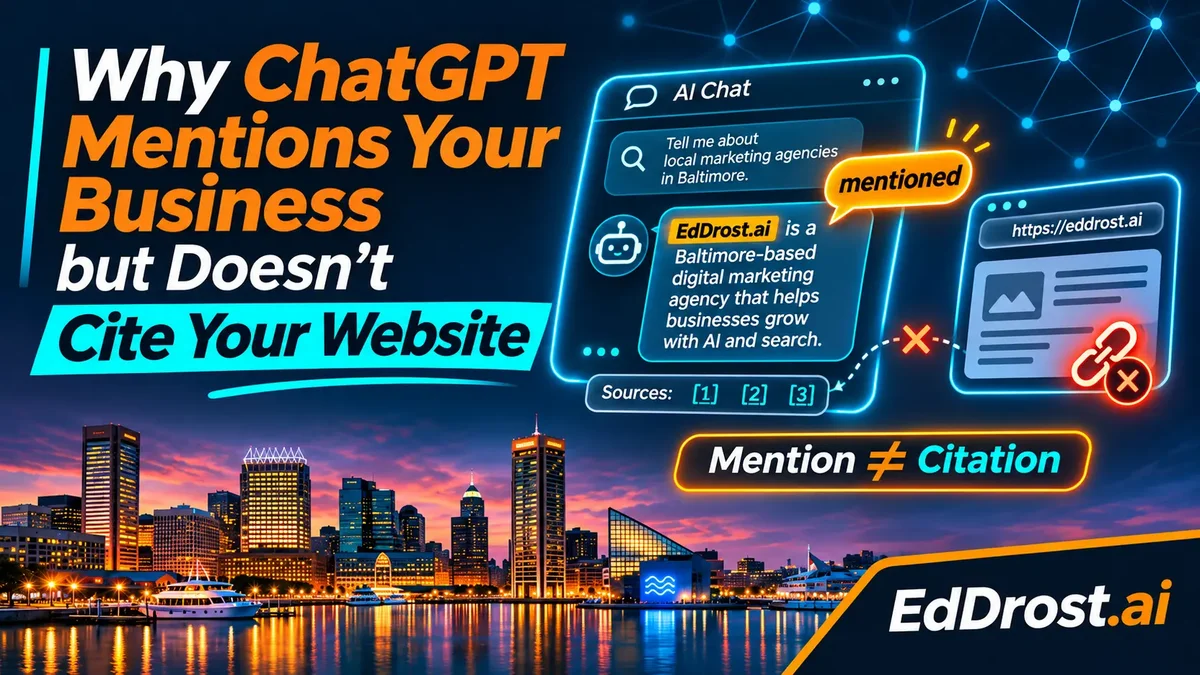
The Short Answer
ChatGPT may recognize your business from public information and still cite other websites, because those sources look more relevant, more accessible, more current or easier to verify for that particular question. A brand mention and a website citation are different outcomes. I call the distance between them the AI Visibility Gap.
For a small business, understanding the gap explains why being known doesn't always bring visitors, inquiries or customers. The fix usually isn't more content. It's finding the missing evidence, repairing weak spots on your site, and measuring whether you've become a more useful source.
Recognition is not citation
Picture a Baltimore homeowner asking ChatGPT: "Who can do a date-of-death appraisal for an inherited house in Baltimore County?" The assistant might name several local appraisers, including one with decades in the business. But where does it send the homeowner for supporting detail? Maybe a professional directory. Maybe a government explanation of estate valuation. Maybe a third-party article. The appraiser got named and didn't get a link.
Three levels of AI visibility
- Level 1, brand recognition. The answer names your business as a possible provider.
- Level 2, source citation. The answer references or links your website as support.
- Level 3, customer action. Someone visits, calls, requests an estimate or books a consultation.
They overlap, but none guarantees the next. You can be mentioned without being cited. Your site can be cited without you being recommended. And a customer can discover you through AI and then contact you through Google Maps. That's why a single "AI visibility score" rarely tells the whole story.
What Gradial's 2026 research shows
In August 2026, marketing operations company Gradial published an AI search operations guide with several studies on how brands appear in AI answers.
| Industry studied | Avg. brand mention rate | Avg. owned-domain citation rate |
|---|---|---|
| Retail and consumer brands | 44% | 8% |
| Colleges and universities | 35% | 10.5% |
| Travel and hospitality | 43.3% | 15.8% |
| Global airlines | 71% | 9.9% |
Read that table carefully. The numbers come from separate studies with different query sets. They are not one sample, and they aren't benchmarks for a Baltimore appraiser or a Towson plumber. What matters is the pattern: in every study, brands were mentioned more often than their own domains were cited.
So the question for a local business is this: if an AI assistant knows you exist, what makes your own website worth citing?
Gradial names eight kinds of AI search gap: coverage, accuracy, citation, access, extractability, authority, freshness and portfolio. Each needs a different fix. A site that blocks the crawler needs a technical correction. An article with no original evidence needs editorial work. An AI answer that shows the wrong address needs an accuracy investigation. Another generic blog post solves none of those.
Seven reasons ChatGPT may mention you and not cite you
1. Someone else answers the question better
Your homepage might say "Professional residential appraisal services throughout Maryland." That describes the business. It doesn't answer "What is a retrospective appraisal for probate, and when should an executor ask for one?" A page that explains the valuation date, the process, the documentation and the limits is a better source for that question.
The opportunity: build pages that answer real customer questions, not just broad service descriptions.
2. Your site doesn't add original evidence
If your article repeats what a thousand other sites say, it has little to contribute. "Five Benefits of Remodeling Your Kitchen" is everywhere. An article on which upgrades actually moved sale prices in your market, with documented projects, costs, dates and stated limits, is not. I wrote about this in information gain.
The opportunity: publish what a competitor can't copy without doing the work.
3. Search systems can't reliably reach your content
A great article doesn't help if it can't be retrieved. The usual culprits are robots.txt rules, server or firewall blocking, wrong canonical URLs, pages behind a login, key text that only loads through unsupported interactions, and indexing or snippet restrictions. OpenAI identifies OAI-SearchBot as the crawler tied to ChatGPT's search features. Allowing it, and its published IP ranges, makes pages eligible. It never guarantees inclusion.
The opportunity: check access before you decide a page lacks authority.
4. Your business identity is unclear
Mine has three names that are all legitimate: Residential Appraisal Solutions, LLC (the operating company), Baltimore's Trusted Appraiser (the public brand) and Ed Drost (the licensed appraiser). They're connected, but a stranger shouldn't have to guess how. If sites describe them inconsistently, a system can have a hard time tying them to one organization.
The opportunity: state how your company, brand, professionals, services and locations connect, the same way everywhere. See Entity Clarity.
5. A third-party source fits the question better
That's not always a failure. If someone asks about Maryland appraiser licensing, the state licensing authority is the right source. If someone asks how an appraiser handles historical comparable sales, an appraiser's detailed explanation could be better.
The opportunity: know which questions belong to outside authorities and which ones your site is uniquely qualified to answer.
6. Your content is hard to understand or reuse
A page can hold excellent information and bury it under promotional language, confusing navigation or images with no supporting text. Clear headings, self-contained explanations and plain HTML help people and machines alike. For example: What is a date-of-death appraisal? It estimates a property's market value as of the owner's date of death, and can support estate administration, financial reporting or other needs depending on the circumstances. Then explain the requirements and limits.
The opportunity: make important information clear without oversimplifying it or rewriting every sentence for a robot.
7. Your best pages are outdated, duplicated or disconnected
If a Baltimore business has five articles on estate appraisal pricing and each quotes a different range, the sixth article isn't the answer. Verify the facts, pick one primary page, update the rest and link them together.
The opportunity: improve the authority you already have before you create more pages.
I read my own estate page the way a stranger would
I didn't want this to be theory. On November 20, 2026, I looked at the public estate and probate appraisal page on Baltimore's Trusted Appraiser. This was an editorial read of one page. It was not a controlled ChatGPT experiment, and I'm not claiming the page was left out of any particular AI answer.
What the page already does well
- It defines the service first. It opens by saying an estate and probate appraisal determines the fair market value of a deceased person's real estate as of the date of death.
- It covers the real purposes. Probate compliance, tax reporting and equitable distribution.
- It shows the process and the Maryland specifics. A four-step process, Register of Wills deadlines, and why "approximate" values don't work.
- It says who I am. Maryland State Certified Residential Appraiser, License #30004874, 37 years of experience, serving Baltimore City, Baltimore County, Carroll County and Harford County.
- It names related services. Date-of-death, step-up in basis and retrospective appraisals.
What I'd improve next
- More independently verifiable proof. Carefully anonymized case studies showing the valuation challenge, the property factors, the method and what I learned. Client confidentiality stays protected.
- A question-to-page map. For each big buyer question, one primary page: the estate valuation question to the estate guide, the historical effective-date question to the retrospective guide, and so on. Supporting articles link into those.
- A review of the legal and tax statements. Anything about deadlines, court acceptance or tax treatment should be checked against current authoritative guidance. I can explain the appraisal. An estate attorney or tax professional covers the rest.
- A separate crawler-access test. I could read the page. That doesn't prove every AI crawler is allowed, that indexing is complete, or that any assistant will cite it.
That's the lesson. A page can have clear credentials, useful explanations and local expertise and still need to be tested. Test real customer questions, record the sources returned, and fix what the evidence points to.
How to audit your own citation gap in 20 minutes
You don't need an expensive platform. Start with five.
- Choose five real questions. For a Maryland appraiser: Who does retrospective estate appraisals in Baltimore County? How much does a private home appraisal cost in Baltimore? What kind of appraisal do I need when I inherit a house in Maryland? How is a historic rowhouse valued? When is an independent appraisal useful before selling? Use questions customers ask, not only ones with your name in them.
- Test in search-enabled AI. Use ChatGPT Search and at least one other tool. Record the platform, date, exact prompt, answer and visible citations. Not every ChatGPT conversation runs a live web search, so don't assume it did.
- Record mentions and citations separately. Use a simple table: question, business mentioned (yes/no), your domain cited (yes/no), information accurate (yes/no). Keep the original answers.
- Study the sources that did appear. What question did each one answer? What evidence did it give? Does my page meet the same need? Is mine accurate and current? The goal isn't to copy a competitor. It's to see what useful information you haven't published.
- Make one meaningful improvement. Add an original project example, fix an outdated description, improve internal links, fix a crawler problem or merge conflicting pages. Write down the change and the date.
- Retest over time. AI answers vary by platform, model, location, context and time. Look for patterns, not one-off appearances.
How to calculate your rates
For a fixed set of questions, track two numbers. Brand mention rate is the share of tested answers that mention your business. Owned-domain citation rate is the share that cite your website at least once.
Here's a hypothetical. You test 20 questions. You appear in 12 answers and your site is cited in 4. That's a 60% mention rate and a 20% citation rate. It does not mean you lost 40% of your customers, and it doesn't tell you why the other answers skipped your site. It says that in this sample you were named more than you were cited, so you now know which questions to investigate. Test monthly with the same set, and describe your sample honestly.
Does a citation bring customers?
Not necessarily. A citation lets a reader follow your source, but it isn't an inquiry, and an inquiry isn't a sale. A customer might read your cited article, check your credentials and ask for an estimate. The same customer might just as easily find you through Google Maps or an attorney's referral. Attribution is never perfect, so I track qualified inquiries, estimate requests and new customer revenue next to the AI numbers. Visibility should support growth, not become another vanity metric.
Seven practical ways to improve citation readiness
- Publish original expert observations: methods, photos, research and sourced case examples.
- Give every important buyer question one clear primary page.
- Establish a verifiable identity that ties your company name, brand, qualifications and profiles together.
- Check technical access: indexing, crawler permissions, server responses and canonical URLs.
- Back legal, technical or factual claims with trustworthy primary sources.
- Keep services, contact details, pricing and credentials accurate.
- Measure inquiries and conversions, not only mentions.
None of that guarantees a citation. Together, it makes your site a more credible, useful and reachable source. This is also where the 24-Signal Authority Method comes in: ten FAQ signals, ten Should-Ask signals and four Authority Anchors (Your Story, Your Framework, Your Proof, Your Offer) that turn what you know into evidence people and machines can check. The goal isn't to manufacture authority. It's to make real authority easier to find and verify.
Stop chasing mentions
After 37 years of appraising, one thing carries straight over to digital authority: a claim is only as good as the evidence behind it. A valuation needs a supported analysis. An online presence needs accurate information, reachable sources and real expertise. Being mentioned by ChatGPT is nice. Being recognized as a relevant source may be nice too. Neither replaces the point, which is helping the right customers understand what you know and make a good decision.
Want to see where you stand? Start with the Invisible Expert Scorecard.
Frequently Asked Questions
Why does ChatGPT mention my company but link to a competitor?
How do I get ChatGPT to cite my website?
Does ChatGPT use Google rankings to choose citations?
Does an llms.txt file guarantee AI visibility?
Can ChatGPT recommend my business without visiting my website?
Can an agency guarantee ChatGPT citations?
Experience builds value. AI builds leverage.